Upstox has redefined India’s fintech landscape with a funding journey that has captured the attention of investors and traders alike. In this article, we reveal the 7 most important facts about upstox funding in 2026, offering a clear look at its investors, soaring valuation, and rapid growth.
You’ll discover Upstox’s total funding, major backers, unicorn status, funding rounds, valuation milestones, and why these matter for the entire trading and fintech sector.
Ready to dive into Upstox’s funding milestones? Explore exclusive insights and learn what sets this fintech leader apart, so you can better understand the ecosystem shaping India’s digital future.
Upstox in 2026: Company Overview and Market Position
Upstox has emerged as a defining force in India’s fintech sector, continually setting benchmarks in digital trading and investment. Its journey from a nimble startup to a market leader is a testament to innovation, strategic vision, and the power of upstox funding. The company’s story encapsulates the evolution of online trading in India, inspiring a new generation of investors and traders.
Upstox’s Evolution in the Indian Fintech Sector
Founded in 2009 by Ravi Kumar, Kavitha Subramanian, and Shrini Viswanath, Upstox began as RKSV Securities with a clear mission: democratize access to trading for every Indian. The platform’s early adoption of technology enabled it to offer low-cost brokerage, intuitive trading tools, and seamless digital onboarding. Over the years, upstox funding played a pivotal role in scaling operations.
Key milestones include the launch of a mobile-first trading app in 2017, reaching one million users by 2019, and surpassing 20 million users by 2026. Upstox’s core offerings have expanded to cover stocks, mutual funds, IPOs, commodities, and digital gold, catering to both beginners and advanced traders.
Compared to competitors like Zerodha and Groww, Upstox stands out for its aggressive user acquisition and product innovation. The company has consistently received industry accolades, such as “Best Retail Broking Platform” and recognition for driving financial inclusion.
Upstox funding has enabled continuous platform upgrades, enhanced security protocols, and the launch of educational initiatives. These investments have supported exponential growth in active trading volumes, cementing the company’s reputation as a technology-first brokerage.
The company’s impact extends beyond numbers. By lowering entry barriers and offering robust digital infrastructure, Upstox has empowered millions to participate in India’s capital markets for the first time.
The Fintech Investment Landscape in 2026
By 2026, India’s fintech sector is characterized by unprecedented investor enthusiasm, robust regulatory support, and relentless innovation. Upstox funding reflects this broader trend, with capital inflows not just fueling growth, but reshaping the competitive landscape.
Fintech funding in India has seen record highs, with digital trading platforms attracting significant attention. Investors are drawn to the sector’s scalability, recurring revenue models, and vast untapped user base. Upstox’s ability to secure substantial funding aligns with sector-wide optimism and signals strong confidence in its business model.
Relative to other unicorns, Upstox commands a sizable market share, rivaling established players and outpacing many new entrants. Strategic use of upstox funding has allowed the company to invest in technology, compliance, and user experience, positioning it favorably against both domestic and global competitors.
Regulatory initiatives, such as streamlined KYC processes and open banking frameworks, have further accelerated sector growth. Economic stability and rising financial literacy rates also contribute to the sector’s momentum.
For a detailed comparative look at how funding shapes fintech winners and market leaders, explore this Fintech funding trends overview which provides insights into the evolving landscape and the dynamics behind investor decisions.
In summary, Upstox’s journey exemplifies the transformative power of strategic funding in fintech. The company’s rise mirrors the sector’s growth, highlighting the symbiotic relationship between innovation, capital, and market leadership.
The 7 Key Facts About Upstox Funding in 2026
Upstox funding has become a benchmark for success in India's fintech sector. In 2026, the company's journey from a lean startup to a unicorn with a multi-billion dollar valuation stands as a testament to strategic capital raising, investor confidence, and market disruption. Here, we break down the 7 most important facts about Upstox funding, unveiling the numbers, names, and strategies that shaped its path.
1. Upstox’s Total Funding Crosses $220 Million
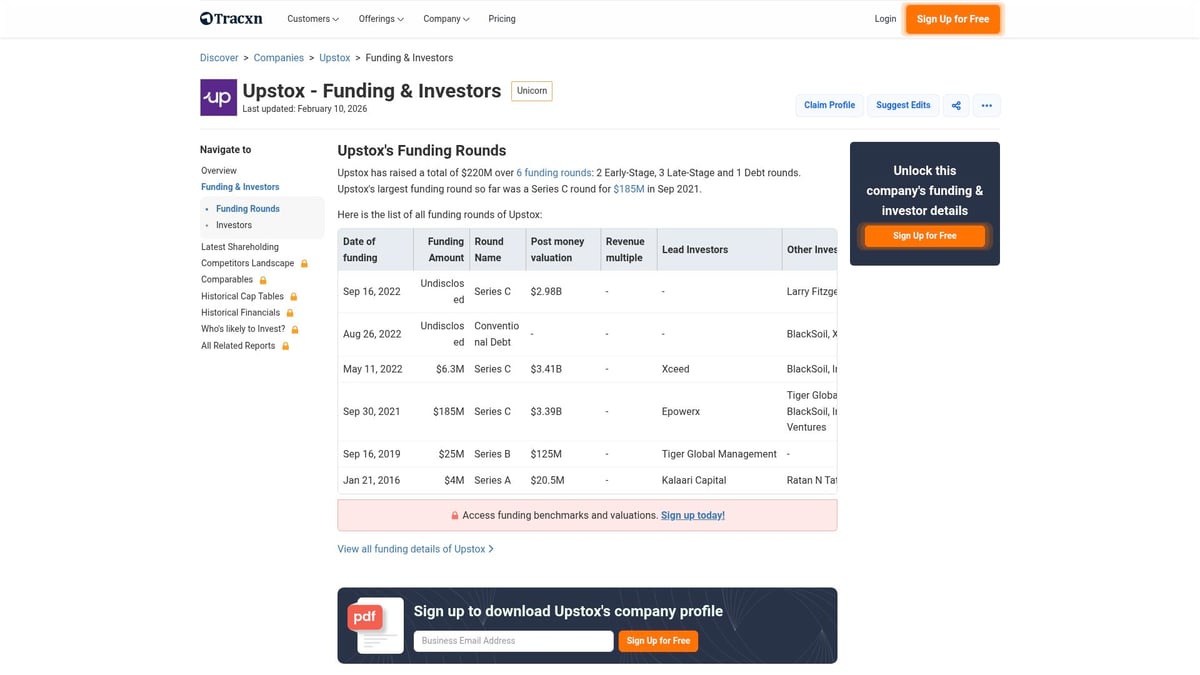
By 2026, Upstox funding reached a cumulative $220 million. This figure marks a remarkable rise from its early days, reflecting robust investor interest and the company's expanding footprint. The funding came through six distinct rounds, including a mix of early-stage, late-stage, and debt financing.
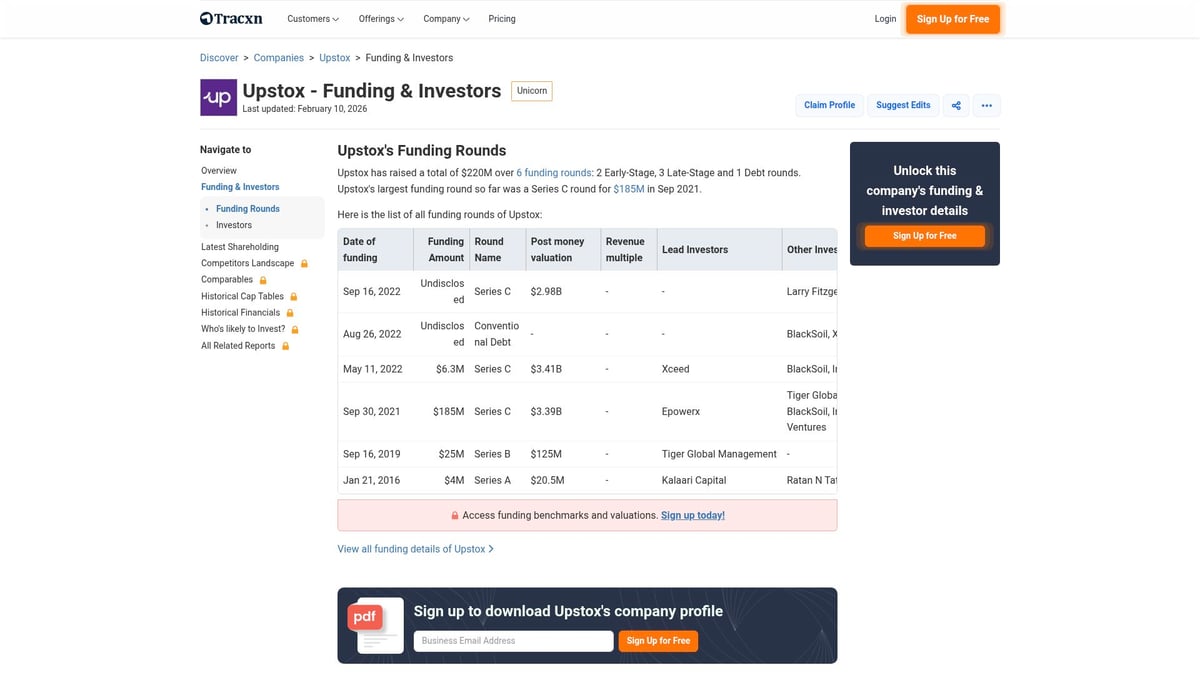
The growth trajectory is evident in the numbers: in 2016, Upstox funding was at $4 million. By 2019, it jumped to $29 million, and by 2021, it soared past $200 million. This steady influx of capital enabled Upstox to invest in technology, launch new investment tools, and enhance trading infrastructure.
What does this mean for users and investors? Sustained Upstox funding ensures the platform can roll out advanced features, scale operations, and maintain a competitive edge. It also solidifies trust among retail investors, who benefit from a platform backed by significant capital. In the brokerage industry, continuous funding is critical for innovation and customer acquisition, making Upstox's journey a case study in strategic capital deployment.
2. Series C: The Largest Funding Round at $185 Million
The Series C round in September 2021 was a defining moment for Upstox funding. This single round brought in $185 million, making it the largest in the company's history. Major players like Epowerx, Tiger Global, BlackSoil, Stride Ventures, and others participated, signaling strong institutional confidence.
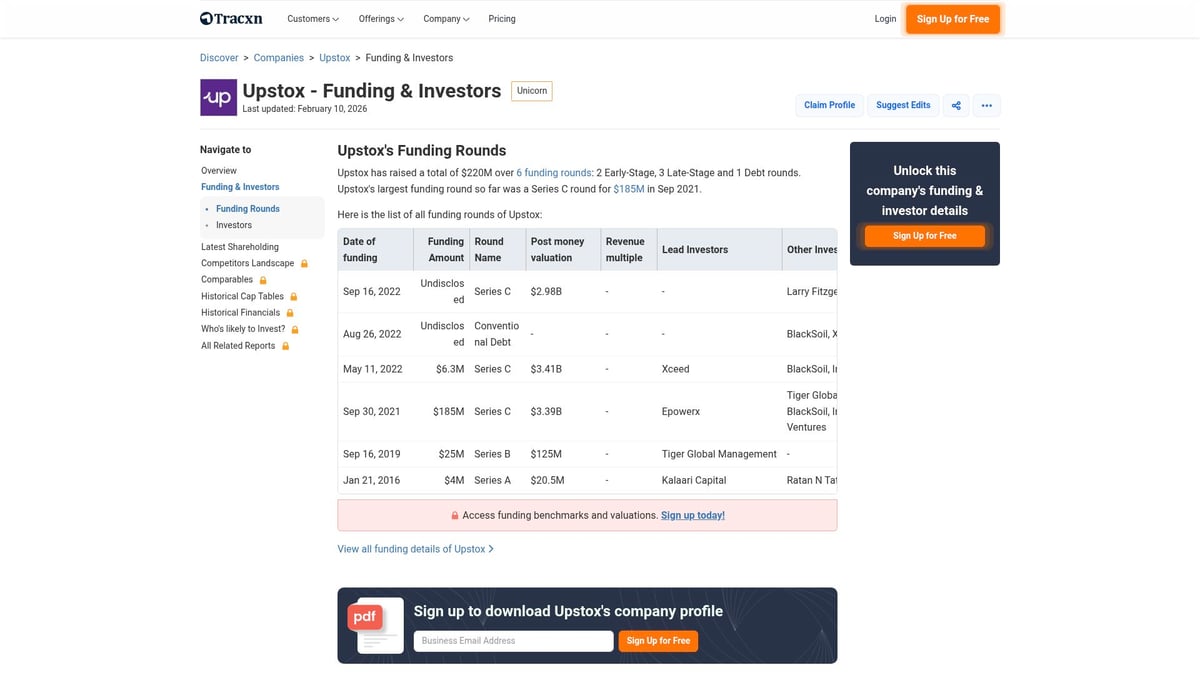
This infusion pushed Upstox's valuation into unicorn territory. The capital was strategically allocated to technology upgrades, user base expansion, and deeper market penetration. Compared to Series A ($4M) and B ($25M), Series C was a quantum leap, reflecting Upstox’s rapid scaling and growing ambitions.
The impact of this Upstox funding round was immediate. The company accelerated product innovation, entered new market segments, and doubled down on digital security. The post-money valuation and revenue multiples also attracted further investor interest, positioning Upstox as a leader among digital brokerages.
3. Upstox Achieves Unicorn Status with $2.98 Billion Valuation
Upstox funding milestones culminated in the company achieving unicorn status. A unicorn, in fintech, refers to a startup valued at over $1 billion. Upstox first crossed this threshold in 2021 and reached a $2.98 billion valuation by September 2022, according to market data.
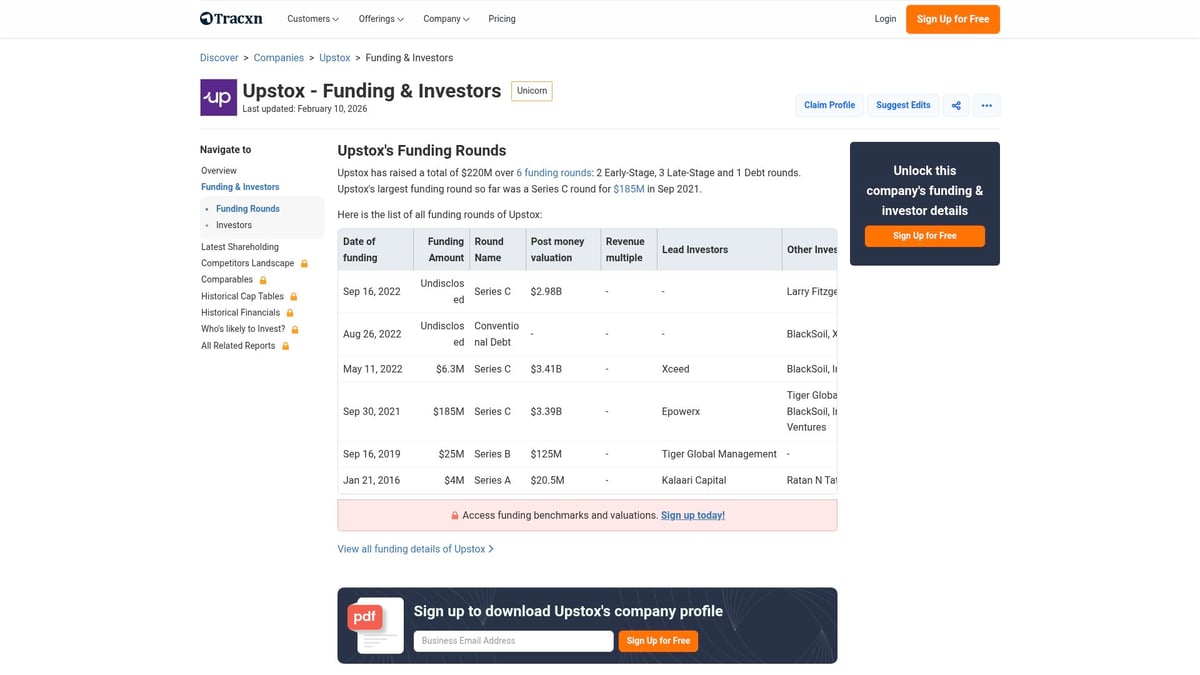
Several factors drove this meteoric rise: exceptional user growth, robust revenue streams, and a technology-driven model. Upstox funding played a pivotal role, enabling the company to outpace competitors and capture significant market share.
Compared to other Indian fintech unicorns, Upstox stands out for its rapid valuation growth and sustainable business model. The impressive revenue multiples and financial performance underline its strong fundamentals. This level of Upstox funding also instills confidence in both existing and prospective investors, reinforcing the company’s position at the forefront of India’s digital finance revolution.
4. Diverse Investor Base: 26 Institutional and Angel Investors
Upstox funding is distinguished by its diverse and strategic investor base. Twenty-six investors have backed the company, including fourteen institutional firms and twelve high-profile angel investors. Key institutions such as Kalaari Capital, Tiger Global, BlackSoil, Xceed, Stride Ventures, Epowerx, and Innoven Capital have played significant roles.
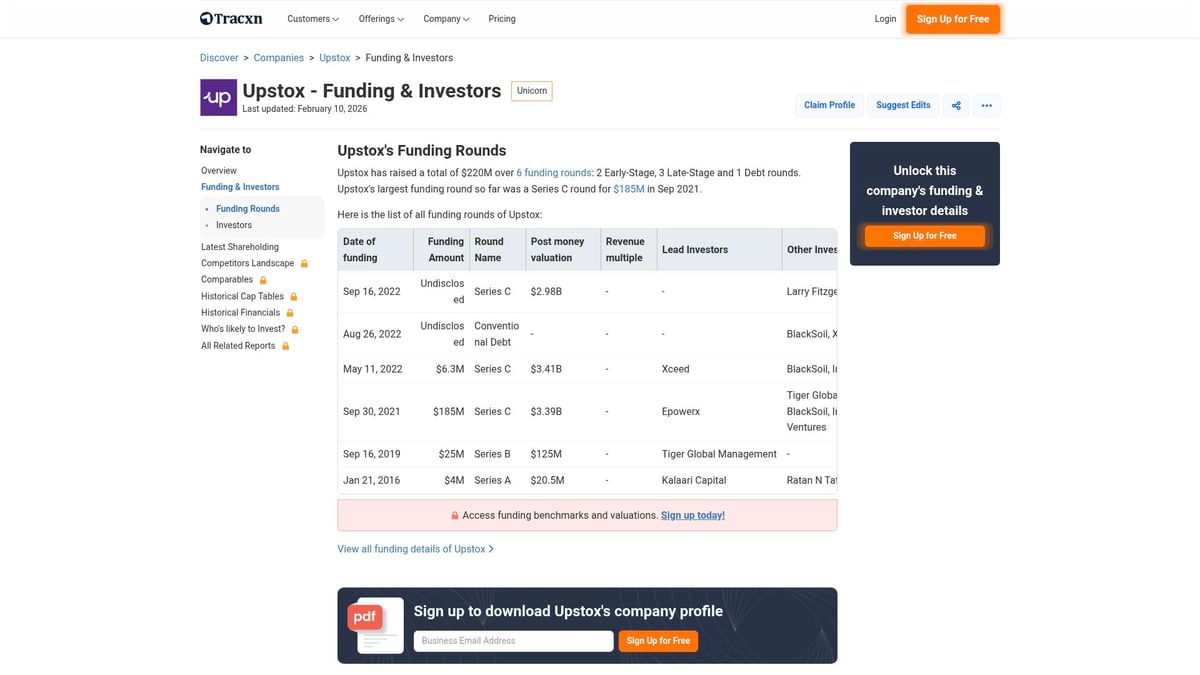
Notable angel investors include industry stalwarts like Ratan N Tata, Larry Fitzgerald, and Kal Somani. The geographic spread of investors, from India to the US and beyond, has been instrumental in shaping Upstox’s global vision.
This broad investor mix does more than provide capital. It brings advisory expertise, strategic networks, and credibility to Upstox funding rounds. For a detailed overview of major investors and their contributions, Upstox’s Funding and Key Investors offers an in-depth exploration.
Each investor’s entry marked a new phase in Upstox’s evolution. Their ongoing support reflects deep confidence in the company’s growth trajectory and its ability to deliver value in the competitive fintech landscape.
5. Strategic Use of Debt Funding
Upstox funding strategy includes not just equity but also debt financing. In August 2022, the company completed a conventional debt round, tapping investors like BlackSoil and Xceed. This approach provided operational flexibility without diluting ownership.
Why choose debt over equity? Debt funding supports liquidity needs, infrastructure scaling, and regulatory compliance while preserving founder and early investor stakes. For fintech startups, this can be an agile way to access capital during periods of rapid growth or market volatility.
However, debt does introduce repayment obligations and risk. Upstox funding managers balanced these factors, using debt proceeds to invest in technology, expand services, and ensure regulatory alignment. This prudent mix of funding types helped the company optimize its capital structure and reinforce its market position.
6. Milestone Funding Rounds: From Series A to C
The story of Upstox funding is marked by a series of milestone rounds, each fueling a new phase of growth. Here’s a snapshot:
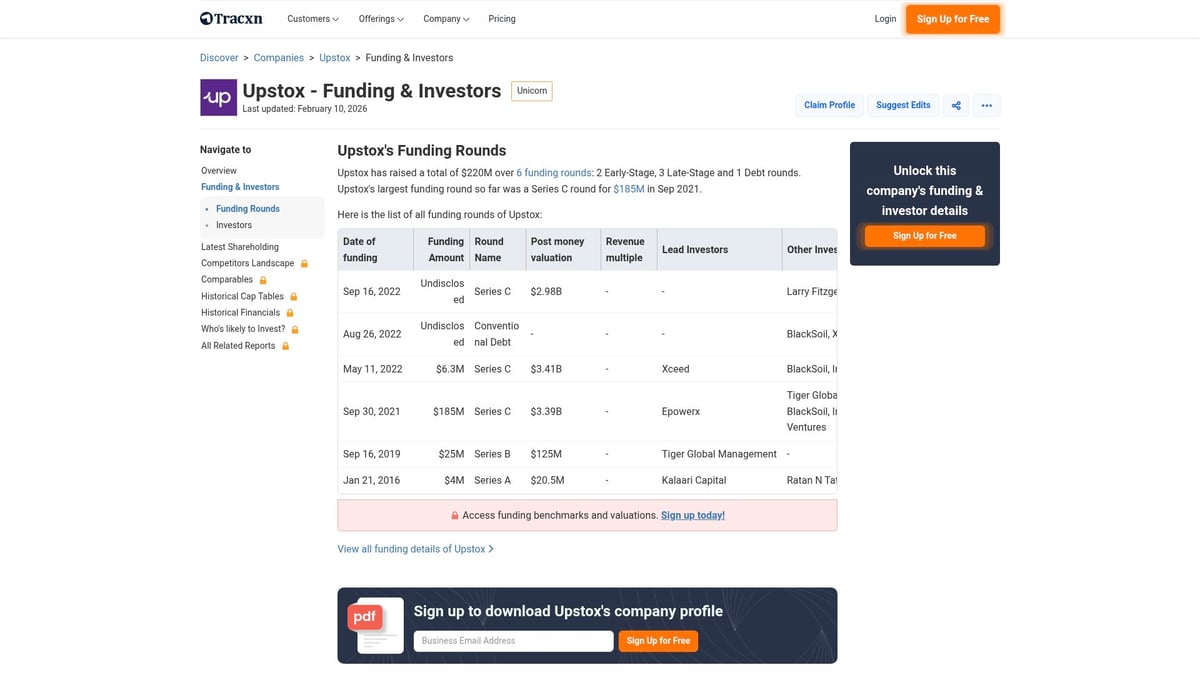
| Funding Round | Year | Amount | Key Investors | Post-Money Valuation |
|---|---|---|---|---|
| Series A | 2016 | $4M | Kalaari Capital | Not disclosed |
| Series B | 2019 | $25M | Tiger Global, GVK Davix | Not disclosed |
| Series C | 2021 | $185M | Tiger Global, Epowerx, Stride Ventures | $2.98B (2022) |
Each round of Upstox funding paved the way for new product launches or market entries. Series A capital supported the initial platform build and early user acquisition. Series B enabled scaling and entry into new segments. Series C powered aggressive expansion, technology upgrades, and a diversified product suite.
Lessons from Upstox funding rounds include the importance of timing, investor alignment, and clear growth milestones. For fintech startups, this model demonstrates how staged funding can accelerate innovation and market leadership.
7. [Upstox’s Funding Impact: Market Expansion and User Growth]
The real measure of Upstox funding lies in its tangible impact. Each investment round translated directly into user acquisition, product diversification, and market share gains. With a growing war chest, Upstox expanded beyond stock trading into mutual funds, IPOs, digital gold, and more.
Capital was invested in cutting-edge technology, robust security systems, and a seamless user experience. Strategic partnerships and collaborations, often enabled by Upstox funding, unlocked new markets and drove regional growth.
Key data points highlight this impact: Upstox’s user base surged into the millions, active trading volumes set new records, and revenue growth outpaced sector averages. High-profile campaigns, innovative product launches, and regional expansion further cemented its leadership in India’s digital investment ecosystem.
Upstox funding continues to drive democratization of financial services, making investing accessible to a broader population and setting new benchmarks for the entire fintech industry.
Upstox’s Funding Compared to Other Indian Fintech Unicorns
India’s fintech boom has brought several trading platforms into the spotlight, but upstox funding stands out for its scale and diversity. To fully appreciate Upstox’s journey, it is crucial to compare its funding, valuation, and investor profile with other leading unicorns such as Zerodha, Groww, and Angel One.
Benchmarking Upstox’s Funding Journey
When benchmarking upstox funding, it is clear that Upstox has attracted significant capital compared to its peers. For instance, Upstox crossed the $220 million mark across multiple funding rounds, while Groww and Angel One have raised $390 million and $39 million respectively. Zerodha, unique in its bootstrapped approach, has not raised external funding but still commands a multi-billion dollar valuation.
Here’s a snapshot of the funding and valuation figures for India’s top fintech unicorns:
| Company | Total Funding (USD) | Latest Valuation (USD) | Major Investors |
|---|---|---|---|
| Upstox | $220M | $2.98B | Tiger Global, Kalaari, Ratan Tata |
| Groww | $390M | $3.0B | Sequoia, YC, Tiger Global |
| Zerodha | $0 (Bootstrapped) | $3.6B | Self-funded |
| Angel One | $39M | $2.2B | ICICI Venture, Others |
Upstox’s unicorn status, achieved in 2021, signaled its arrival among India’s elite startups. According to the Times of India, Upstox became the 40th unicorn of that year, a testament to investor confidence and market traction.
What sets upstox funding apart is the diversity of its investor base, including both global giants and prominent Indian backers. The mix of institutional and angel investors, such as Tiger Global, BlackSoil, and Ratan Tata, has supported Upstox’s rapid expansion and robust technology upgrades.
For startups, the lesson is clear: attracting a mix of strategic investors and focusing on sustainable user growth can drive both valuation and long-term resilience.
The Role of Global and Local Investors
The upstox funding story is also shaped by the interplay between global and domestic investors. International funds like Tiger Global have brought not just capital, but also strategic expertise and access to global best practices. Local investors, on the other hand, have provided crucial market insights and regulatory guidance.
India’s fintech sector has seen a surge in cross-border investments, reflecting growing confidence in digital trading platforms. As highlighted in the Economic Times report, fintech funding in India reached $2.4 billion in 2025, with both domestic and international investors contributing to the momentum.
The ability of upstox funding to appeal to a broad range of investors has helped the company scale quickly, enter new product segments, and enhance its market share. By leveraging both global capital and local expertise, Upstox has positioned itself as a leader in India’s competitive fintech landscape.
For emerging fintech startups, balancing international partnerships with strong local roots remains a critical strategy for attracting funding and driving innovation.
FAQs About Upstox Funding and Investors
Navigating the world of upstox funding can be complex, especially for investors and users seeking clarity on growth and investment trends. Here, we address the most pressing questions about Upstox’s funding journey, major investors, and future prospects.
Most Common Questions Answered
How much total funding has Upstox raised as of 2026?
Upstox funding has surpassed $220 million by 2026, secured across multiple rounds. This achievement highlights Upstox’s ability to attract significant capital in a competitive fintech market.
What is Upstox’s latest valuation and unicorn status?
Upstox achieved unicorn status after its Series C round, reaching a valuation of $2.98 billion in September 2022. This milestone cemented its leadership in India’s fintech sector.
Who are the major investors and when did they invest?
Upstox’s investor base includes prominent names such as Tiger Global, Kalaari Capital, BlackSoil, and angel investors like Ratan Tata. Their participation spans from early rounds in 2016 to recent expansions.
How many funding rounds has Upstox completed?
By 2026, Upstox has completed six funding rounds, including Series A, B, and C, as well as a strategic debt round. Each round has contributed to scaling operations and product offerings.
What is the significance of the largest funding round?
The Series C round, raising $185 million, was pivotal for upstox funding. It enabled large-scale technology upgrades, new product launches, and market expansion.
How does Upstox’s funding compare to peers?
| Company | Total Funding | Valuation (2026) | Unicorn Status |
|---|---|---|---|
| Upstox | $220M | $2.98B | Yes |
| Zerodha | $0 | $3.6B | Yes |
| Groww | $390M | $3.2B | Yes |
| Angel One | $20M | $2.1B | Yes |
Upstox’s funding stands out for its mix of equity and debt, and its diverse investor profile.
What are the future prospects for Upstox based on its funding history?
Strong upstox funding signals robust growth potential. The company is expected to leverage its capital for further product innovation, technology investments, and deeper market penetration.
For additional insights, visit our FAQs on funding and investors to explore related topics and in-depth answers.
As you’ve seen, understanding Upstox’s funding journey gives you valuable insights into what it takes to succeed in the dynamic world of trading and fintech. From diverse investor backing to strategic funding rounds, Upstox’s story highlights the importance of having the right support and resources as a trader. If you’re inspired to take your own trading ambitions to the next level, why not explore the opportunities waiting for you? You can unlock your potential and aim for real profit sharing by accepting a challenge with a trusted partner. Ready to take the next step? start today