The world of elite trader funding is changing rapidly, opening new doors for ambitious traders in 2026. Are you prepared to seize these emerging opportunities?
This guide serves as your comprehensive roadmap, designed to help you navigate elite trader funding’s rules, evaluation programs, and payout systems with confidence. Our goal is to break down the complex structure and challenges, making it easier for you to make informed decisions.
Inside, you’ll discover the latest updates on account structures, risk management strategies, pricing models, and actionable steps for maximizing your funded trading success. Whether you’re new or experienced, this resource empowers you to pursue financial independence with clarity.
Ready to unlock your potential? Let’s dive in and start your journey toward trading freedom.
Understanding Elite Trader Funding in 2026
Elite trader funding has transformed the way traders access capital, offering a direct route to larger accounts without traditional barriers. In 2026, this model is more advanced, transparent, and competitive than ever before. To make the most of elite trader funding, it is essential to understand its origins, structure, demographics, features, and market positioning.

What Is Elite Trader Funding?
Elite trader funding emerged in 2022, quickly gaining traction for its innovative approach to futures trading. Unlike many firms, it focuses exclusively on futures contracts, offering access to indices, commodities, and treasury markets. The platform stands out with multiple evaluation programs, flexible rules, and a high Trustpilot rating of 4.1 from over 1,100 reviews, reflecting strong trader satisfaction.
Founded by experienced industry professionals, elite trader funding prioritizes transparency and trader empowerment. Its unique selling points include a variety of challenge types, high payout potential, and a trader-centric design. These factors distinguish it from traditional prop firms and drive its popularity among futures traders.
The Three-Tier Account Structure
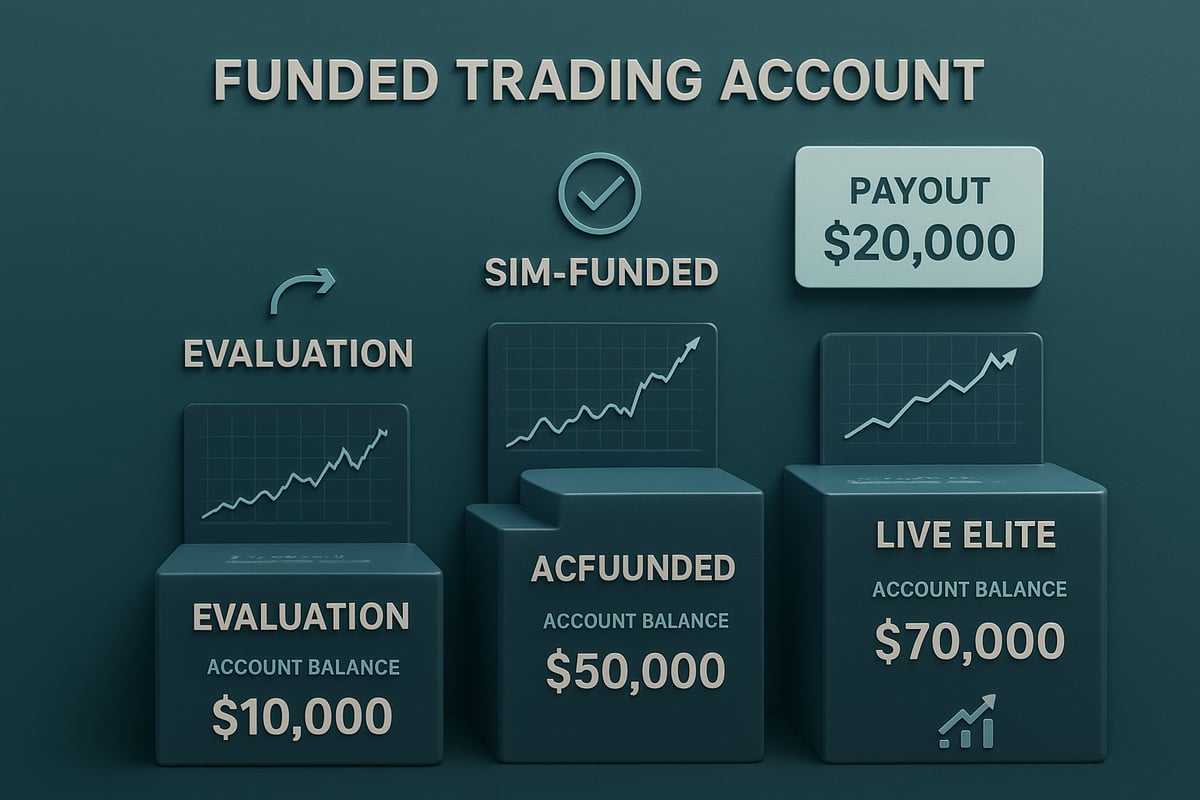
Elite trader funding operates a clear three-tier account structure: Evaluation, Sim-Funded (also known as "Elite"), and LIVE Elite accounts. Traders begin with the Evaluation phase, where they must meet specific performance targets. Upon passing, they advance to Sim-Funded accounts, which use demo environments but provide real payout opportunities.
The highest level, LIVE Elite, involves trading with real capital and is accessible by invitation only. There are no public criteria for receiving an invitation, which raises transparency concerns for some. This structure allows elite trader funding to reward top performers while keeping risk managed, but the lack of clarity around LIVE Elite access can be a source of frustration for ambitious traders.
Trader Demographics and Success Rates
Elite trader funding has funded over 2,000 traders in Sim-Funded accounts, distributing more than $10 million in payouts. Its evaluation pass rate sits between 15 and 20 percent, notably higher than the industry average. The platform attracts a diverse mix of scalpers, swing traders, and position traders, with a primary focus on the US market but open to global participants.
Typical success stories include disciplined traders who excel at risk management and strategy adaptation. However, common pitfalls include misunderstanding rules or overleveraging. By understanding these trends, traders can better position themselves for success within elite trader funding’s framework.
Key Features and Platform Integrations
A major strength of elite trader funding is its compatibility with top-tier futures platforms such as Rithmic and Tradovate. Account sizes range from $10,000 to $300,000, allowing flexibility for traders of different experience levels. Users can operate up to 20 accounts with a single login, making scaling strategies more accessible.
Only pure futures assets are available, with no CFDs offered. Payment and withdrawal options include credit and debit cards, RiseWorks, USDC, and traditional bank transfers. These integrations ensure elite trader funding remains accessible and technologically advanced, catering to the needs of modern traders.
Pros and Cons in 2026’s Market Context
Elite trader funding’s flexible evaluations, generous initial profit split, and clear rules make it a leading choice for many traders in 2026. It excels in offering multiple pathways to funding and supports a wide range of trading styles. However, the ambiguity around Sim-Funded and LIVE Elite criteria, combined with monthly fees, may deter some.
Compared to competitors, elite trader funding stands out for its transparency in most areas and higher pass rates. It is particularly beneficial for traders seeking a structured, futures-only environment. As prop trading evolves with new technology and regulation, elite trader funding’s adaptability positions it well for continued growth and relevance.
Step-by-Step Guide to Elite Trader Funding Evaluations
Navigating the elite trader funding evaluation process in 2026 means understanding a variety of programs, each tailored to different trading styles and risk appetites. With multiple paths to funding, traders must carefully assess which evaluation fits their strengths and goals. This section will guide you through each program, highlight key differences, and provide actionable insights to help you choose and conquer your path to a funded account.
Overview of the Five Evaluation Programs
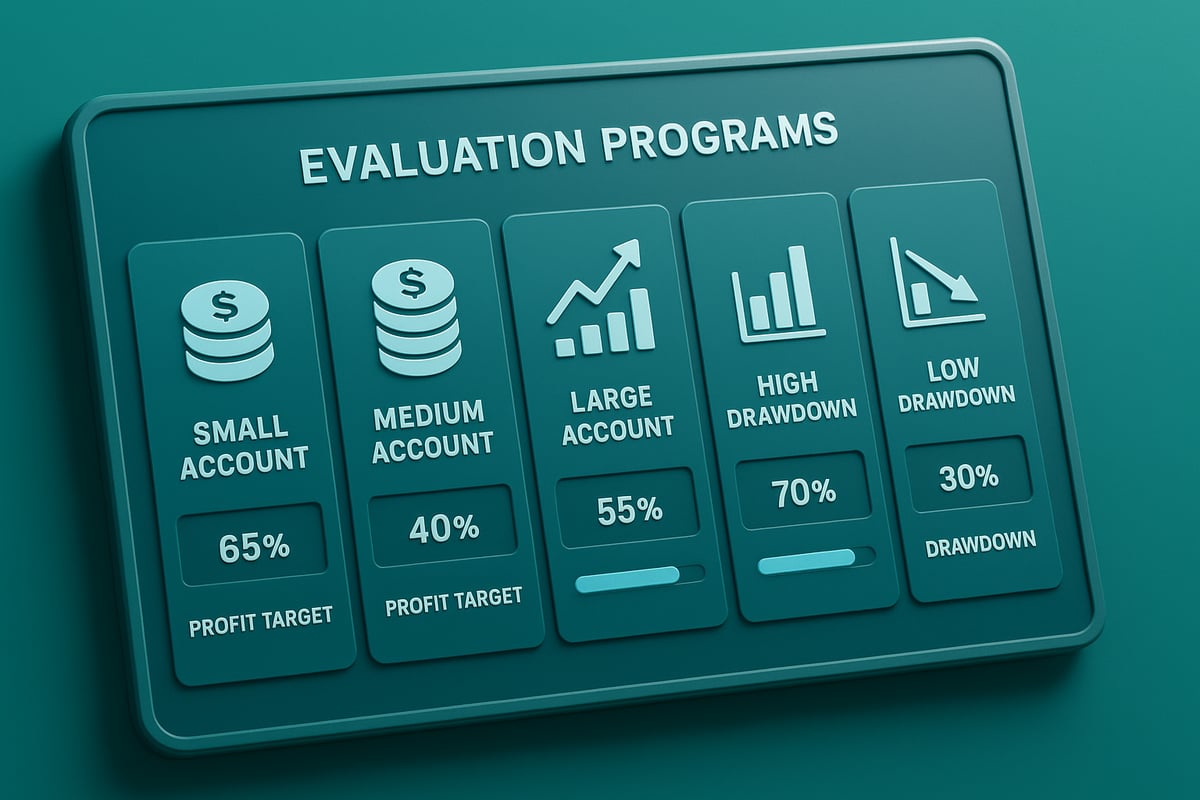
Elite trader funding offers five main evaluation programs, each engineered for a unique type of trader. Choosing the right program is crucial—matching your strategy to the evaluation rules can make the difference between passing and resetting.
Here’s a quick comparison:
| Program | Account Sizes | Profit Target | Drawdown Type | Best For |
|---|---|---|---|---|
| 1-Step | $50K–$300K | 6–7% | Trailing | Intraday Traders |
| EOD Drawdown | $50K–$300K | 6–7% | Trailing (EOD) | Swing Traders |
| Fast Track | $100K–$250K | 6–7% | Trailing | Aggressive Scalpers |
| Static Drawdown | $10K–$50K | 8–10% | Static | Position Traders |
| Diamond Hands | $100K | 6% | Trailing (EOD) | Overnight Traders |
Each program comes with its own set of rules, profit targets, and risk controls. To dive deeper into how these structures compare to other prop firm challenges, see this prop firm evaluation programs guide.
1-Step Evaluation: The Standard Path
The 1-Step Evaluation is the flagship offering from elite trader funding and appeals to those who thrive on intraday strategies. Account sizes range from $50,000 up to $300,000, with profit targets typically set at 6 to 7 percent.
A key feature is the trailing drawdown, which follows your account’s highest unrealized equity point. This requires careful management, as any significant intraday gains can tighten your risk buffer. Traders must complete at least five trading days, but there is no time limit, allowing for a disciplined approach.
Daily loss limits (1.7–2.2 percent) and position caps are enforced based on account size. Overnight holding is not allowed. Monthly fees start at $80 and can reach $515, depending on the account size. The flexibility and transparency of this program make it a preferred entry point for many elite trader funding participants.
EOD Drawdown Evaluation: For Swing Traders
The EOD Drawdown Evaluation is tailored for swing traders who need more room for intraday volatility. Like the 1-Step, it offers $50,000 to $300,000 accounts and similar profit targets, but the trailing drawdown only updates at the end of each trading session.
This means your intraday swings do not immediately affect your drawdown, which is a significant advantage for those holding positions throughout the day. The daily loss is calculated based on the prior day’s balance, and Sunday and Monday count as one trading day.
Traders must still complete at least five trading days, with no overall time limit. The elite trader funding structure here rewards patience and allows for more flexible trade management during volatile markets.
Fast Track Evaluation: High-Risk, High-Reward
For aggressive traders, the Fast Track Evaluation delivers a condensed, high-stakes challenge. Account sizes are set at $100,000 or $250,000, and traders have a hard time limit of either 10 or 14 days to meet a 6–7 percent profit target.
There are no resets if you fail, and monthly fees are lower than other programs. This instant pass-or-fail structure means only those with a proven edge and the ability to handle pressure should attempt it.
The Fast Track is ideal for elite trader funding applicants who want a rapid result, either moving quickly to funding or restarting without prolonged uncertainty. Scalpers and high-frequency traders often gravitate to this program for its speed and clarity.
Static Drawdown Evaluation: Fixed Risk, Higher Targets
The Static Drawdown Evaluation is designed for traders who prefer predictable risk parameters. Account sizes range from $10,000 to $50,000, and the drawdown is fixed—it does not trail your equity highs.
Profit targets are higher, at 8 to 10 percent, and there is no daily loss limit. The minimum trading period is five days, but there is no maximum, letting you pace yourself.
This program appeals to position traders who want to avoid the “phantom” losses that can occur with trailing drawdowns. While harder to pass due to the elevated targets, the static structure offers more control and transparency for elite trader funding participants seeking consistency.
Diamond Hands: Overnight and Weekend Trading
Diamond Hands is the only elite trader funding program allowing overnight and weekend positions. The account size is fixed at $100,000, with a 6 percent profit target and an EOD trailing drawdown.
A minimum of five trading days and a 20-contract limit apply. This program is custom-built for swing and trend traders who want to capture multi-day moves and do not mind additional overnight risk.
While Diamond Hands opens new opportunities, especially in trending markets, it demands careful risk management. The exposure to overnight gaps means traders must be vigilant and adaptable, making this the most advanced evaluation path within elite trader funding for 2026.
Navigating the Funded Account Process
Starting your elite trader funding journey means understanding every stage of the funded account lifecycle. The process is designed to reward discipline, consistency, and adherence to specific rules. Let us walk through how traders move from evaluation to real capital, what rules govern each phase, and how to scale your success.
From Evaluation to Sim-Funded Account
Once you pass the evaluation phase with elite trader funding, you are transitioned to a Sim-Funded, or "Elite," account. This account operates in a simulated environment but grants real payout privileges.
Your trailing drawdown continues from the evaluation, protecting both you and the firm until you reach a preset profit threshold. After surpassing that threshold, your drawdown becomes static, providing a safety net for your gains. For example, a $100,000 account will keep the trailing drawdown until you realize $3,000 in profit, then lock in at a fixed value. This structure motivates careful trading and gradual account growth at every elite trader funding stage.
Sim-Funded Account Rules and Payout Structure
Sim-Funded accounts in elite trader funding offer a compelling payout structure. You keep 100% of your first $12,500 in profits, then 90% beyond that. Before your initial payout, you must complete at least 8 Active Trading Days, each requiring $200 in realized profit and at least 23% of your best day's P&L.
Payouts are processed weekly, typically on Wednesdays, with an $80 monthly activation fee for each funded account. For a full breakdown of drawdown mechanics, payout eligibility, and rule compliance, refer to the Elite Trader Funding account rules. Understanding these rules is essential for maximizing your elite trader funding experience.
The 40% Consistency Rule
Elite trader funding enforces the 40% consistency rule to ensure steady performance. No single day's profit can exceed 40% of your total profits at the time of payout. This prevents outsized, "lottery-style" trades from dominating your results and encourages reliable trading behavior.
For example, if your total profits are $10,000, no single day should contribute more than $4,000. This rule primarily applies to Sim-Funded accounts purchased before August 1, 2024. Planning your trades and spreading profits across multiple days is crucial to avoid consistency violations and maintain eligibility for elite trader funding payouts.
Transitioning to LIVE Elite Accounts
LIVE Elite accounts represent the pinnacle of elite trader funding, offering access to real capital and daily payouts. Transition is by invitation only, based on internal reviews of your Sim-Funded performance. There are no public criteria for selection, which creates some uncertainty for traders.
Anecdotal reports suggest some receive invitations after three or four successful payout cycles, while others may wait longer. LIVE Elite accounts are managed via EdgeClear, feature no consistency rule, and provide a more flexible trading environment. Clarity on selection criteria would enhance transparency for all elite trader funding participants.
Managing Multiple Accounts and Scaling Up
Elite trader funding allows you to manage up to 20 accounts under a single login. This flexibility enables diverse scaling strategies, such as running several $50,000 and $100,000 accounts simultaneously to stack income streams.
When scaling, consider account-specific limits, such as simultaneous payout requests and position limits. Diversification can reduce risk, but overextending may lead to rule breaches or account failures. Careful risk allocation, disciplined trading, and attentive rule management are vital to scaling your elite trader funding operation successfully.
Elite Trader Funding Payouts: Rules, Limits, and Strategies
Elite trader funding payouts are designed to reward consistent, disciplined trading while ensuring both the trader and the firm are protected. Understanding payout rules, drawdown requirements, and withdrawal processes is essential to maximizing your earnings and avoiding common pitfalls. This section breaks down everything you need to know to navigate elite trader funding payouts with confidence.
Profit Split and Payout Structure
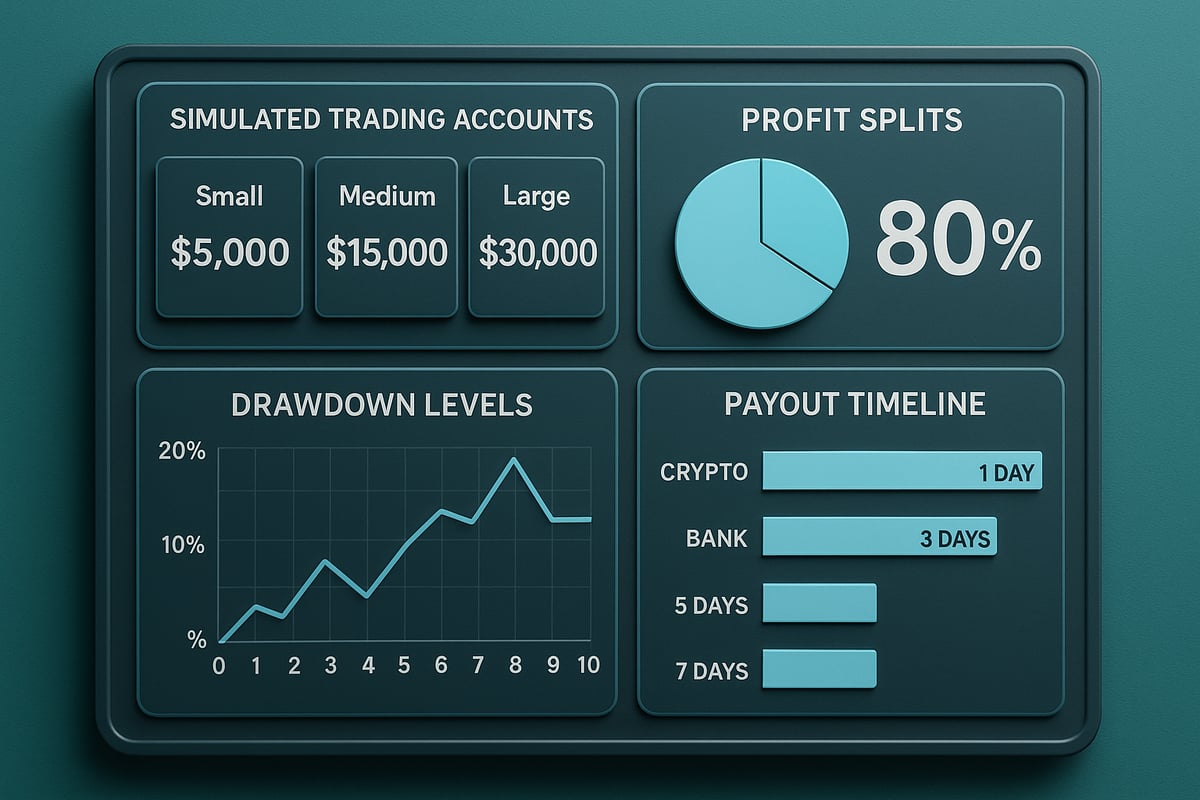
Elite trader funding offers a competitive payout model that rewards early profits. Traders receive 100 percent of the first $12,500 in profits across all accounts. After reaching this threshold, the profit split shifts to 90 percent for the trader and 10 percent for the firm. For example, if you earn $20,000, your total payout would be $19,250.
| Profit Tier | Trader Share | Firm Share |
|---|---|---|
| First $12,500 | 100% | 0% |
| Above $12,500 | 90% | 10% |
This structure incentivizes steady, early gains and encourages traders to build a solid track record. According to 2022 stats, over 1,700 traders earned $1.75 million in profits, with $630,000 paid out. Elite trader funding's payout model is especially attractive for those who prioritize early consistency.
Drawdown Types and Safety Net Requirements
Elite trader funding uses both trailing and static drawdown models, depending on the account type. A trailing drawdown follows your highest equity point, while a static drawdown remains fixed. For example, a $100,000 account might have a $3,000 trailing drawdown that locks in as you realize profits.
The Safety Net requirement means you must have realized profits at least equal to your account’s max drawdown plus $100 before requesting a withdrawal. For a $100,000 account with a $3,000 drawdown, you need $3,100 in realized profit before your first withdrawal. This rule protects both the trader and the firm, helping sustain long-term funded trading.
Static account minimums are as follows:
- $10,000 account: $9,500 balance
- $25,000 account: $24,000 balance
- $50,000 account: $48,000 balance
Active Trading Days and Consistency Requirements
To qualify for elite trader funding payouts, traders must complete a minimum number of Active Trading Days. For the first two payouts, you need 15 Active Trading Days (10 if your account was purchased after October 1, 2024), then 10 days for subsequent payouts.
An Active Trading Day is defined as achieving $200 in realized profit and at least 23 percent of your best day’s profit. For example, if your top day was $1,000, each qualifying day must have at least $230 in profit. Sunday and Monday are counted as one trading day. These requirements encourage consistent performance over time.
For a detailed breakdown of all rules and compliance steps, review the Funded trading account rules page.
Payout Process: Step-by-Step
Requesting a payout from elite trader funding is a streamlined process. Once you meet the eligibility criteria, submit your request through the online dashboard. The system will automatically verify your Active Trading Days and Safety Net requirements.
Trading activity is paused during the payout review, usually for up to 24 hours. Sim-Funded account payouts are processed every Wednesday, while LIVE Elite accounts receive daily payouts. Here is a typical payout timeline:
- Meet all trading and profit requirements
- Submit payout request via dashboard
- Pause trading for review (up to 24 hours)
- Receive payout on the next scheduled cycle
This process ensures transparency and minimizes delays for elite trader funding participants.
Payment Methods and Processing Times
Elite trader funding leverages the RiseWorks platform for all payments. Before your first withdrawal, you must complete KYC verification. Payment options include USDC via Coinbase (instant), blockchain wallet transfers (under 1 hour), and international bank transfers (1–3 days).
Sim-Funded accounts receive payouts weekly, processed on Wednesdays. LIVE Elite accounts can request daily payouts, providing greater flexibility. For the fastest access to funds, many traders choose USDC on Coinbase, which is usually completed within minutes.
Payout Restrictions and First 3 Cycle Caps
During your first three payout cycles, elite trader funding enforces caps based on account size. For example, a $100,000 account is limited to a $2,500 payout in cycle one, with caps increasing each cycle before being removed.
These restrictions are designed to maintain account stability and protect against rapid drawdowns. Planning withdrawals strategically helps maximize long-term earnings. If you earn a large profit early, consider spreading withdrawals across multiple cycles to avoid hitting payout caps.
Understanding these rules helps you set realistic expectations and manage your elite trader funding journey for sustained profitability.
Elite Trader Funding Pricing and Value Analysis
Understanding the pricing structure is critical for anyone considering elite trader funding. The firm's cost model is transparent yet nuanced, with monthly fees, resets, and ongoing funded account charges. These elements can impact both short-term and long-term profitability, especially as you plan your evaluation journey.
Evaluation and Funded Account Fees
Elite trader funding operates on a monthly subscription model, charging traders until they pass the evaluation or choose to cancel. For example, a $100,000 1-Step account costs $235 per month, while the $50,000 account is $160. Once funded, traders pay an $80 monthly fee to maintain their Sim-Funded account. Active subscriptions allow free monthly resets, which is valuable for those needing more attempts.
Here's a quick comparison table:
| Account Size | 1-Step Monthly Fee | Funded Account Fee |
|---|---|---|
| $10,000 | $80 | $80 |
| $50,000 | $160 | $80 |
| $100,000 | $235 | $80 |
| $300,000 | $515 | $80 |
Passing in one month minimizes costs, but taking three months can quickly increase your total investment with elite trader funding.
Reset Fees and Rewards Program
Resetting an evaluation with elite trader funding costs $75 unless your monthly subscription is active, in which case resets are free. The platform also offers a rewards program, awarding one point for every dollar spent. Traders can redeem 1,250 points for a free reset or 4,200 points for a $100,000 Fast Track evaluation.
This system benefits frequent evaluation buyers or those who use multiple accounts. While not a game-changer for all, the rewards program can save money over time, especially if you actively pursue several elite trader funding accounts or need multiple resets to pass.
Comparing ETF Pricing to Competitors
Elite trader funding stands out with its monthly model, as many competitors use one-time evaluation fees. This lowers upfront risk, giving traders the flexibility to cancel anytime, but costs can accumulate if you take longer to pass. In 2026, prop firm pricing trends are moving toward subscription-based models, making cost comparison essential.
For a detailed look at how elite trader funding compares to other top futures prop firms, you can read the Elite Traders Funding overview. Understanding these differences helps you decide whether the monthly or one-time fee approach aligns better with your trading style and pace.
Cost-Benefit Analysis for Different Trader Types
Elite trader funding offers the most value to fast passers who clear evaluations in one or two months. Methodical or risk-averse traders may face higher total fees, especially if they need several attempts. Calculating your ROI means weighing subscription and funded fees against realistic payout caps and your trading performance.
Payout rules, like initial withdrawal caps, affect net earnings in the early stages. To maximize value, minimize resets, pass quickly, and plan withdrawals around the cap schedule. Ultimately, elite trader funding rewards traders who match their pace and style to the program's fee structure and rules.
Essential Rules, Risk Management, and Compliance Tips
Understanding and mastering the rules of elite trader funding is crucial for long-term success. Every trader should internalize these guidelines before risking capital, as even small mistakes can result in account termination or loss of payout eligibility. Let’s explore the essential rules, risk management tactics, and compliance strategies that every elite trader funding participant needs to know.
Core Trading Rules and Pitfalls
Elite trader funding programs enforce strict trading rules to protect both traders and the firm. Each account type has specific position limits, such as 10 contracts for a $50K account. Daily loss limits apply for 1-Step and EOD programs, requiring all positions to be closed before the market session ends unless you are in the Diamond Hands evaluation.
Major pitfalls include holding trades overnight in non-eligible programs or exceeding daily loss or position limits. Breaching these rules leads to instant account failure and forfeiture of any pending payouts. Traders must read every rule carefully, as even a minor oversight can end their elite trader funding journey abruptly.
Trailing vs. Static Drawdown Mechanics
Elite trader funding offers both trailing and static drawdown models, each with unique risk implications. In a trailing drawdown, the maximum loss threshold moves up as new profit highs are reached. This means a large intraday gain can shrink your drawdown cushion, resulting in potential "phantom" losses if profits are not locked in.
Static drawdown, by contrast, offers a fixed risk buffer that does not change with equity swings. This predictability appeals to position traders who value clear risk boundaries. Understanding which model fits your strategy is essential for success with elite trader funding, as mismanaging drawdown can quickly jeopardize your funded status.
Compliance With Consistency and Safety Net Rules
Staying compliant with elite trader funding requirements means tracking both the 40% consistency rule and the Safety Net. The consistency rule ensures no single day's profit exceeds 40% of total profits at payout, discouraging reckless "lottery ticket" trades. The Safety Net requires realized profits to exceed the maximum drawdown plus $100 before withdrawals are permitted.
Common compliance mistakes include miscounting active trading days or misunderstanding payout eligibility. To avoid costly errors, consult the official Elite Trader Funding terms of service for the latest rules, and use dashboards or trade journals to monitor progress. This diligence will help you maintain your elite trader funding account and maximize payout opportunities.
Psychological and Strategic Risk Management
Elite trader funding is as much a psychological challenge as it is a technical one. Emotional discipline is critical, especially during evaluations or after a string of losses. Traders should avoid "all-in" trades that violate rules in an attempt to recover quickly.
Adapting your trading style to fit elite trader funding’s constraints is key. Focus on sustainable, consistent profits rather than chasing quick wins. Leverage the variety of evaluation programs to match your strengths, and always maintain a long-term perspective. This mindset, combined with robust risk management, sets the foundation for lasting success in elite trader funding.
Advanced Strategies for Success with Elite Trader Funding
Selecting the right path within elite trader funding is crucial for long-term achievement. Each evaluation program is tailored for a specific trading style, so start with a candid self-assessment. Are you an intraday scalper, a swing trader, or do you prefer holding positions for several days? Compare program rules closely. For example, the Static Drawdown program has stricter profit targets but fixed risk, while Diamond Hands allows overnight holds for swing strategies. Understanding industry-wide prop trading success rates can help you gauge your odds and set realistic expectations. Align your strengths with the evaluation program’s structure to maximize your edge in elite trader funding.
Choosing the Right Evaluation Program for Your Style
To optimize your elite trader funding journey, match your personality and trading strengths to the program features. Intraday traders may thrive in the 1-Step or Fast Track programs, which reward quick decision-making and frequent trades. Swing or position traders often prefer EOD Drawdown or Diamond Hands, which allow trades to develop over longer timeframes. Be sure to review rule details like drawdown types, daily loss limits, and contract caps. For example, a scalper might avoid Static Drawdown due to its higher targets and lack of daily loss limits. Adapting to new 2026 program adjustments is essential for ongoing success with elite trader funding.
Maximizing Payouts and Account Longevity
Developing a strategy for consistent withdrawals is key to maximizing your elite trader funding profits. Plan your trading to avoid early payout caps, and always track your Active Trading Days to ensure eligibility. Diversifying across multiple accounts can help stack income and reduce risk, but be cautious not to overextend. Building a strong performance record increases your chances for a LIVE Elite invitation, where payout rules are more favorable. Use each evaluation phase as an opportunity to refine your discipline and demonstrate steady, sustainable results. Longevity in elite trader funding often comes down to careful planning and strict adherence to rules.
Leveraging Platform Tools and Community Resources
Take full advantage of the robust platforms integrated with elite trader funding, such as Rithmic and Tradovate, to analyze trades and optimize execution. Engage with trader communities to share insights, discover new strategies, and stay updated on policy changes. Monitoring statistics and learning from top performers, both within the ETF ecosystem and through competitor analysis like this Elite Funding Trader review, can provide valuable benchmarks. Use dashboards and trade journals to track compliance with key rules. Staying proactive with technology and peer support is vital for adapting to 2026’s rapidly evolving trading landscape.
Future Outlook: Evolving Opportunities in Funded Trading
The funded trading ecosystem is poised for significant change, with elite trader funding likely to introduce greater transparency and possibly new pathways to LIVE Elite accounts. As competition intensifies, expect more innovative evaluation programs and enhanced trader support. Staying informed about regulatory trends and technological advancements will help you future-proof your strategies. Adaptability is essential—regularly reassess your approach as market conditions and program rules evolve. Ultimately, embracing a growth mindset and leveraging all available resources will position you for ongoing success with elite trader funding.
After breaking down the core strategies and essential rules, it’s clear that success in elite trader funding isn’t just about skill—it’s also about making informed choices and leveraging the right support. Best Funded’s transparent programs, flexible evaluation paths, and strong community give you the tools to carve out your own trading success story in 2026. If you’re ready to put your expertise to the test and take the next step toward financial independence, there’s no better time to start today.