Unlock the doors to elite trading funding in 2026 and set your trading career on a path toward extraordinary growth. The world of elite trading funding is rapidly evolving, offering ambitious traders unparalleled opportunities to access significant capital and showcase their skills on a global stage.
This guide reveals proven strategies, actionable steps, and the latest industry insights designed to help you master elite trading funding programs. You will discover how these funding models work, what top firms look for during evaluations, and which automation and risk management tools can give you a competitive edge.
Whether you are an aspiring trader or seeking to maximize your funded account, this resource provides expert-backed tips and a clear roadmap for success. Are you ready to unlock your trading potential and thrive in the evolving landscape of elite funding?
Understanding Elite Trading Funding in 2026
Elite trading funding is transforming the way skilled traders access capital in 2026. This innovative approach allows traders to manage significant firm capital without risking their own funds, opening new doors for career growth. The rise of elite trading funding means that talented individuals no longer need to rely solely on personal savings or traditional brokerage accounts to scale their trading.
Over the past decade, proprietary trading firms have become the backbone of elite trading funding. These firms offer structured programs where traders prove their ability through evaluation challenges. Once they meet set targets and risk controls, traders receive access to funded accounts. The evolution of these funding models has led to more flexible and trader-friendly pathways, with choices between one-phase and two-phase evaluations, as well as monthly or one-time fee structures.
The landscape of elite trading funding in 2026 is shaped by major industry trends. Automation is at the forefront, with integration of trading bots and algorithmic strategies becoming the norm. Global accessibility has expanded, making funded accounts available to traders from nearly every region. Furthermore, asset class coverage has diversified, now including stocks, futures, and cryptocurrencies within many funding programs.
Let’s compare key metrics that define elite trading funding programs today:
| Firm | Profit Split | Max Drawdown | Payout Frequency | Evaluation Fee |
|---|---|---|---|---|
| Elite Trader Funding | Up to 90% | $2,000 (4-6%) | Weekly | $165/month |
| Apex Trader Funding | Up to 90% | $2,000 (4-6%) | Weekly | $147/month |
| Topstep | Up to 80% | $2,000 (4-6%) | Bi-weekly | $165/month |
Profit splits now reach up to 90 percent, with typical drawdown limits between 4 and 6 percent and payouts occurring weekly or bi-weekly. Elite Trader Funding, for example, stands out with transparent rules, no consistency requirements, and competitive fees. For a detailed breakdown of their model, see the Elite Trader Funding overview.
Unlike older models, today’s elite trading funding programs prioritize transparency and the trader’s experience. There is a growing demand for clear rules, trader-centric policies, and fair evaluation criteria. This shift is driven by a maturing industry and increased competition among proprietary firms to attract top talent.
Technology is a key driver of innovation in elite trading funding. Platforms like TradersPost, TradingView, and TrendSpider now integrate seamlessly with prop firm accounts, allowing traders to automate strategies, analyze performance, and manage risk more effectively. These advancements empower traders to focus on strategy execution and performance, while reducing manual errors and emotional decision-making.
In summary, elite trading funding in 2026 offers a dynamic, tech-enabled pathway for talented traders to access firm capital. With evolving models, expanded global reach, and a focus on transparency, the industry is poised for continued growth. Aspiring funded traders who leverage automation and select the right program can thrive in this exciting new landscape.

The Step-by-Step Process to Secure Elite Trading Funding
Securing elite trading funding in 2026 requires a disciplined, methodical approach. Success depends on choosing the right funding program, preparing for the evaluation, passing the challenge, and transitioning to live trading. By following these steps, traders can maximize their chances of earning a funded account and building a sustainable trading career.

Step 1: Selecting the Right Funding Program
The first step in securing elite trading funding is evaluating proprietary trading firms and their offerings. Not all programs are created equal, so it is crucial to look at several core criteria:
- Fees: Monthly or one-time payments, such as Elite Trader Funding’s $165 monthly fee.
- Profit splits: Many firms offer up to 90 percent, but payout structures vary.
- Drawdown policies: Understand daily and max drawdown limits, like Elite Trader Funding’s $2,000 maximum.
- Payout frequency: Weekly or bi-weekly withdrawals impact cash flow.
- Evaluation models: Compare one-phase (simpler, faster) to two-phase (stricter, more thorough) challenges.
A transparent rulebook is essential for elite trading funding. Firms should clearly state profit targets, such as a $3,000 goal, and outline any restrictions. Flexibility in evaluation, such as allowing traders to choose their preferred asset class or trading style, can be a significant advantage.
Traders should align program features with their strengths and objectives. For example, a conservative trader may prefer lower profit targets and generous drawdown, while an aggressive trader might seek higher leverage and faster payouts. Reviewing these factors ensures the best fit for your elite trading funding journey.
Step 2: Preparing for the Evaluation Challenge
Preparation is vital before attempting the evaluation phase for elite trading funding. Start by setting up a simulated trading environment that mirrors the firm’s rules as closely as possible. Use demo accounts to practice, focusing on consistency and risk management.
Key preparation steps include:
- Understanding rules: Know your profit target, such as $3,000, and drawdown limits.
- Backtesting: Test strategies on historical data to gauge performance under firm parameters.
- Automation: Tools like TradersPost can automate strategy testing and execution, reducing manual errors.
- Performance analytics: Track metrics such as win rate, average loss, and drawdown to identify strengths and weaknesses.
Consistent practice in a simulated environment builds confidence and helps traders internalize the rules of elite trading funding programs. Performance tracking ensures you are meeting targets and not overexposing yourself to risk. Automation can further streamline your preparation, making it easier to transition to live evaluation.
Step 3: Passing the Evaluation Phase
The evaluation phase is the most critical hurdle in the elite trading funding process. Success depends on balancing risk and reward, maintaining discipline, and following the firm’s requirements precisely.
Effective strategies include:
- Risk management: Never risk more than a set percentage per trade, and always use stop-losses.
- Profit target pacing: Spread profits across multiple trades, avoiding excessive risk to hit targets quickly.
- Consistency: Adhere to daily trading limits and avoid large deviations in position size.
- Psychological discipline: Stay calm under pressure, especially after losses or winning streaks.
A case study from one-phase versus two-phase evaluations shows that traders with a clear plan have higher success rates. One-phase challenges may offer faster results, but two-phase models often require more consistent performance.
Common mistakes that cause challenge failures include overtrading, ignoring drawdown rules, and letting emotions dictate decisions. To avoid these pitfalls, study the prop firm evaluation process and learn from the experiences of successful traders.
Remaining focused and methodical greatly improves the odds of passing the evaluation and advancing toward elite trading funding.
Step 4: Transitioning to a Funded Account
After passing the evaluation, traders transition to a funded account and manage real capital. Expectations change, and so must your approach to risk and compliance.
Key considerations:
- New account parameters: Profit splits, drawdown limits, and scaling options may differ from the evaluation phase.
- Risk management: Adjust position sizing and stop-losses to protect firm capital and avoid breaches.
- Payouts and withdrawals: Understand the process for weekly or bi-weekly payouts and any required documentation.
- Compliance: Strictly follow all firm rules to maintain funding status. Breaches can result in account termination and loss of profits.
Most elite trading funding platforms offer ongoing support, educational resources, and community forums. Utilizing these resources can help traders adapt to changing market conditions and compliance requirements.
Maintaining discipline and transparency is essential for long-term success. Consistently following the rules and seeking support when needed can help traders maximize the benefits of elite trading funding and grow their professional trading careers.
Essential Strategies for Success in Funded Trading
Unlocking consistent results in elite trading funding requires more than just skill. Traders must combine strategic planning, advanced risk management, and smart automation to thrive in high-stakes environments. By mastering these essential strategies, you can increase your chances of long-term profitability and account longevity.

Developing a Robust Trading Plan
A clear, rule-based trading plan is the foundation for success in elite trading funding. Start by outlining your entry and exit criteria, position sizing, and asset selection. This structure helps you maintain discipline and adapt to different market conditions.
Adjust your plan to fit the requirements of prop firms, such as specific drawdown or consistency rules. For example, if your firm enforces a 4 percent max drawdown, design strategies that limit daily losses and avoid overexposure. Regularly review your performance metrics, then refine your plan to address any weaknesses.
Key elements of a solid trading plan include:
- Defined risk per trade
- Consistent position sizing
- Clear profit targets and stop-losses
By sticking to your rules, you position yourself for steady growth in elite trading funding environments.
Advanced Risk Management Techniques
Protecting capital is critical for traders in elite trading funding programs. Set daily and overall risk limits to avoid breaching firm drawdown thresholds. Use stop-losses and trailing stops to lock in profits and reduce emotional decision-making.
Managing leverage and position size is essential, especially when trading volatile assets. Surviving a 4 percent drawdown environment requires strict adherence to your risk plan. Integrate risk controls into your automated systems to ensure compliance even when trading at scale.
For more on setting risk parameters and meeting firm requirements, review the trading rules and risk limits that are standard among top elite trading funding providers. Staying informed helps you adapt your approach and avoid common pitfalls.
Leveraging Automation and Trading Bots
Automation is transforming elite trading funding by enabling faster execution, greater consistency, and reduced emotional bias. Platforms like TradersPost, TradingView, and TrendSpider allow you to automate strategies and monitor performance in real time.
To get started, connect your preferred platform to your prop firm account and deploy pre-tested strategies. For example, automating futures trades via Tradovate integration streamlines order flow and ensures precise execution. Use analytics dashboards to track bot performance and adjust parameters as markets evolve.
Remember, over-automation can introduce risks if not monitored. Regularly review bot activity and intervene when needed. By combining automation with disciplined oversight, you can achieve greater consistency and scalability in elite trading funding. Embrace technology, but always keep the human touch in your trading process.
Comparing Top Elite Trading Funding Providers
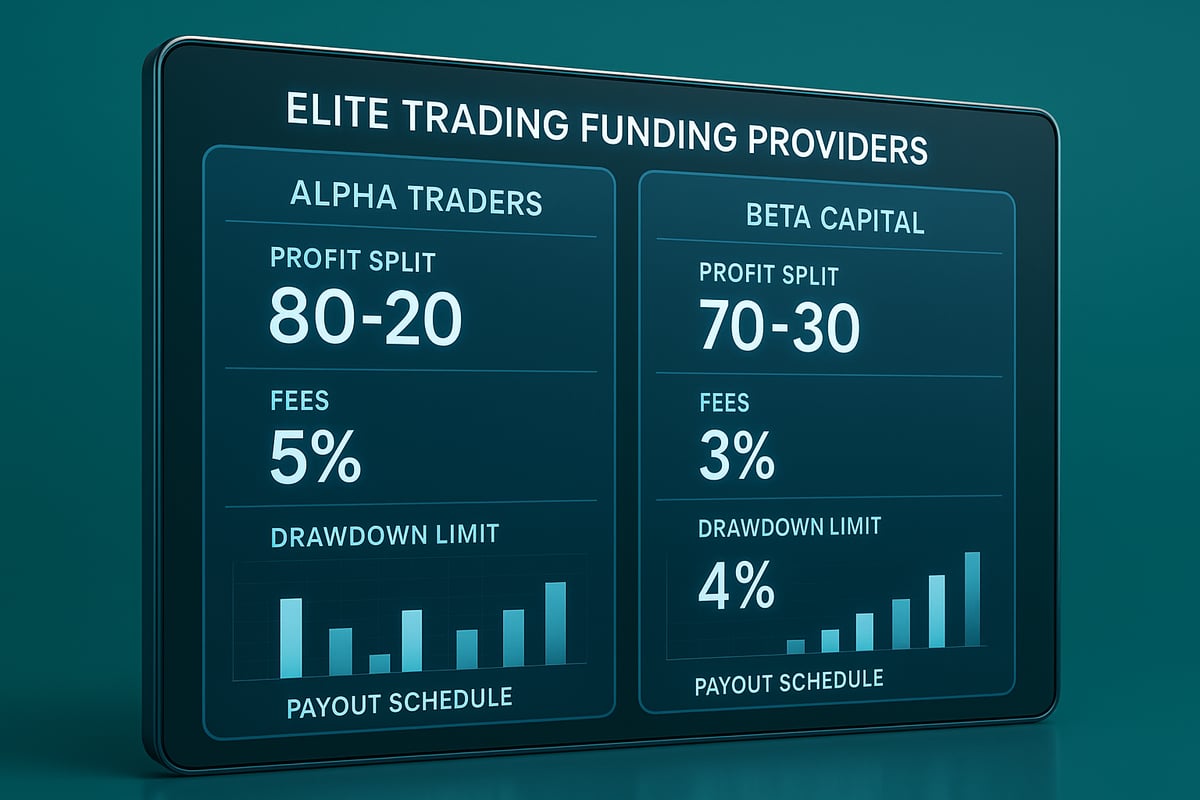
Navigating the landscape of elite trading funding in 2026 means understanding the distinct features that set top providers apart. With more prop firms emerging and industry standards evolving, traders must compare options carefully to maximize their chances of long-term success.
Key Metrics for Evaluation
The elite trading funding market in 2026 is highly competitive, requiring traders to scrutinize every aspect before committing to a provider. Key metrics include fee structures, profit targets, drawdown limits, payout frequencies, and consistency rules. Transparent dashboards and affiliate programs are also becoming standard.
Below is a comparison table summarizing critical data points for leading elite trading funding firms. For a deeper dive and more provider details, see the Best Prop Trading Firms of 2026.
| Firm | Fee Structure | Profit Target | Max Drawdown | Consistency Rule | Payout Frequency | Profit Split | Unique Features |
|---|---|---|---|---|---|---|---|
| Elite Trader Funding | $165/month | $3,000 | $2,000 | No | Weekly | Up to 90% | No daily max, instant payout |
| Apex Trader Funding | $147/month | $3,000 | $2,000 | No | Weekly | Up to 90% | Frequent discounts |
| Topstep | $165/month | $3,000 | $2,000 | Yes | Daily | Up to 80% | Robust education, fast payout |
| Blue Guardian | $150/month | $3,000 | $2,000 | Yes | Bi-weekly | Up to 85% | Scaling plan, risk tools |
| Legends Trading | $155/month | $3,000 | $2,000 | No | Weekly | Up to 88% | Crypto assets, account scaling |
When evaluating elite trading funding providers, always assess how these metrics align with your trading style. Consider whether you prefer monthly or one-time fees and how frequently you wish to withdraw profits.
Strengths and Weaknesses of Leading Firms
Each elite trading funding firm has distinct advantages and potential drawbacks. Elite Trader Funding stands out for its transparent rules, absence of consistency requirements, and weekly payouts. This makes it ideal for traders seeking flexibility and straightforward terms.
Apex Trader Funding often appeals to cost-conscious traders, offering lower fees and no consistency rules. Their regular promotions can further reduce costs, making it accessible for new entrants.
Topstep is renowned for its daily payouts and educational resources, though its stricter consistency requirements may challenge some traders. This firm is often chosen by those who prioritize structure and learning opportunities.
Other firms like Blue Guardian and Legends Trading cater to niche needs, such as scaling plans for aggressive traders or access to diverse assets like cryptocurrencies. These unique offerings can be decisive for traders with specialized strategies.
When choosing among elite trading funding options, weigh the strengths and weaknesses according to your trading objectives. Ask yourself if you value immediate payouts, lower costs, or advanced educational tools most.
How to Choose the Best Fit for Your Trading Goals
Selecting the right elite trading funding provider is as much about personal alignment as it is about metrics. Begin by assessing your trading strategy and risk tolerance. Are you an aggressive trader who thrives on volatility, or do you prefer a more conservative, rules-based approach?
Support and educational resources can make a significant difference, especially for those new to prop trading. Look for firms that offer comprehensive dashboards, quick customer service, and ongoing learning tools.
Withdrawal speed and profit retention are crucial for managing cash flow. Real-world testimonials highlight how traders benefit from weekly or even daily payouts, allowing them to reinvest or withdraw profits as needed.
Some traders diversify by holding multiple funded accounts or switching providers to optimize their earnings and experience. This approach can help spread risk and capitalize on the best features each elite trading funding firm offers.
Ultimately, choose a provider that not only matches your trading style but also supports your long-term growth in the evolving world of elite trading funding.
Common Pitfalls and How to Avoid Them
Navigating elite trading funding programs offers immense opportunity, yet many traders fall into preventable traps that can jeopardize their funded accounts. Recognizing these pitfalls early is essential for maximizing your longevity and profitability in elite trading funding. By understanding common errors and learning how to sidestep them, you can maintain a strong edge as you progress through evaluations and live trading.
Overtrading and Drawdown Violations
One of the most common mistakes in elite trading funding is overtrading, which often leads to breaching strict drawdown limits. Traders may feel pressure to hit profit targets quickly, resulting in excessively frequent trades or oversized positions. This behavior increases the risk of exceeding maximum daily or overall drawdown thresholds, often leading to immediate disqualification.
To avoid this, set clear daily trading limits and stick to predefined risk parameters. Use automated tools to monitor your drawdown in real-time, and consider pausing trading after a losing streak. Elite trading funding programs reward consistency and discipline, not reckless risk-taking.
Misunderstanding Firm Rules and Evaluation Parameters
Another frequent pitfall is failing to fully understand the rules and evaluation conditions set by elite trading funding providers. Each firm has unique guidelines regarding lot sizes, news trading, consistency requirements, and payout eligibility. Small rule violations can lead to account breaches, even if your trading is otherwise profitable.
Stay up to date with industry developments, especially as regulations evolve. For instance, upcoming prop firm rule changes for 2026 may introduce new compliance standards that affect how evaluations are conducted. Always review the latest rulebooks and ask support for clarification when needed to protect your elite trading funding status.
Adapting Strategies to Evaluation Models
Many traders apply personal strategies to elite trading funding challenges without adjusting for program-specific evaluation models. This often results in failing to meet profit targets, violating consistency rules, or triggering hidden restrictions. Each funding program may have unique requirements for trade length, asset class, or risk exposure.
To avoid these issues, backtest your strategy using the exact parameters of your chosen elite trading funding program. Leverage demo accounts to simulate the evaluation environment. Review performance analytics regularly and adapt your approach to align with the firm’s expectations. For broader industry context, see how CTI calls for higher standards in prop firm evaluations to improve transparency and fairness for traders.
Psychological Resilience and Ongoing Learning
Neglecting psychological resilience is a hidden pitfall that can undermine even technically proficient traders in elite trading funding. Stress, fear of loss, or overconfidence often lead to impulsive decisions and rule violations. Building mental discipline is as vital as mastering technical skills.
Join trader communities, seek mentorship, and use educational resources offered by funding platforms. Regular self-assessment and peer feedback can help you adapt to market shifts and firm updates. Remember, success in elite trading funding is not just about passing challenges, but sustaining growth through continuous learning and robust emotional control.
Future Trends and Innovations in Elite Trading Funding
The landscape of elite trading funding is poised for dramatic transformation as we look toward 2026. Technology, market dynamics, and trader expectations are combining to reshape how prop firms operate and the opportunities available to ambitious traders.
The Rise of AI and Algorithmic Trading
AI-driven trading bots are quickly becoming central to elite trading funding programs. These tools empower traders to automate strategies, achieve faster execution, and reduce emotional biases. Prop firms now encourage algorithmic approaches, knowing that consistent, data-driven performance increases the likelihood of long-term success.
Platforms like TradersPost are making it easier for traders to deploy, monitor, and refine automated systems. As AI technologies mature, expect even stricter evaluation criteria that reward disciplined, systematic trading over manual, discretionary methods.
New Asset Classes and Global Reach
Elite trading funding is moving beyond traditional asset classes. In 2026, funded accounts will offer access to crypto, options, and international markets alongside stocks and futures. This broadens the appeal for traders worldwide and allows for greater diversification within funded portfolios.
Global accessibility is further enhanced by remote onboarding and multi-currency support. As prop firms compete for top talent, expect more inclusive programs designed to attract traders from emerging markets and diverse financial backgrounds.
Platform Integration and Transparency
Seamless integration between trading platforms and prop firms is now a top priority. Tools like TradingView and TrendSpider connect directly with funding programs, allowing traders to automate execution and streamline analytics. This drives efficiency and helps firms monitor risk in real time.
Transparency is also gaining ground. Elite trading funding providers are adopting clearer rules, real-time dashboards, and fairer evaluation models. These innovations build trust and empower traders to focus on performance rather than navigating hidden conditions.
Looking Ahead: Predictions and Opportunities
Industry experts predict that profit split ratios in elite trading funding will become even more competitive, with some firms offering up to 90 percent. Evaluation models are likely to evolve, emphasizing adaptability and risk management over raw profit.
According to recent research, prop trading firms remain optimistic for 2025, signaling continued investment in technology and trader support. As automation and transparency advance, aspiring traders will find more opportunities, but also face higher standards for discipline, adaptability, and compliance.
The landscape of elite trading funding in 2026 will reward those who embrace innovation, prioritize risk management, and leverage the latest tools to stay ahead in a rapidly changing market.
After exploring the proven strategies and innovative tools outlined in this guide, you now have a clear roadmap to elevate your trading journey in 2026. Whether you are refining your risk management approach or leveraging automation, the key to success lies in taking action and applying what you’ve learned. Best Funded offers transparent evaluation paths, flexible challenges, and unparalleled support to help you unlock your potential as a funded trader. If you’re ready to put your skills to the test and take the next step toward keeping up to 90 percent of your profits, start today.