In 2026, the surge in prop firm evaluation opportunities has created a highly competitive landscape where traders can secure life-changing funding. For both newcomers and seasoned professionals, mastering the prop firm evaluation process is now the gateway to advancing your trading career and unlocking new earning potential.
As prop firm evaluation models evolve, traders must adapt with fresh strategies and a clear understanding of updated requirements. In this guide, you will discover six essential steps designed to maximize your success rate. Follow these proven steps to boost your chances of passing evaluations and achieving your trading goals in 2026.
Understanding Prop Firm Evaluations in 2026
The landscape of prop firm evaluation has transformed significantly by 2026, reflecting rapid advances in technology and shifting industry standards. As more traders seek funded opportunities, firms have refined their processes, making the evaluation phase both more accessible and more competitive.
The Evolution of Evaluation Models
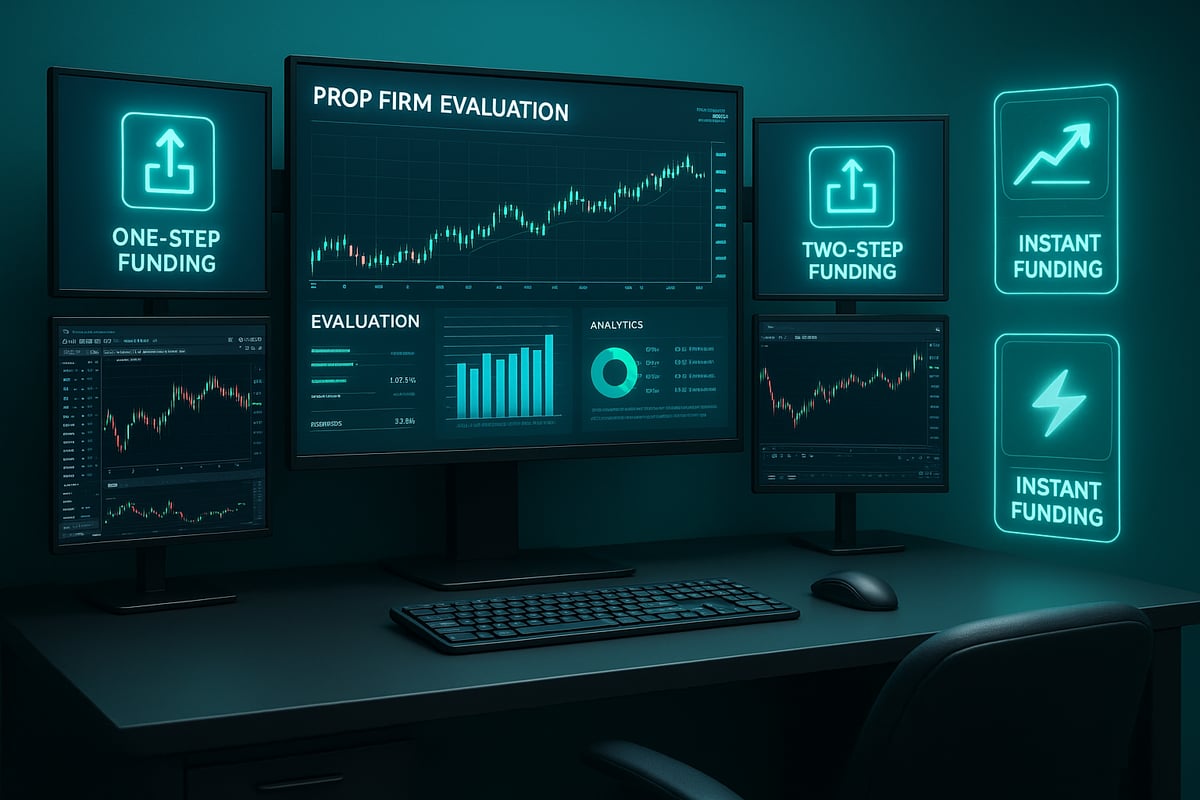
Between 2024 and 2026, prop firm evaluation models have become more diverse and sophisticated. Firms now offer a range of challenge types, each designed to assess different aspects of a trader’s skill set. Traditional two-phase challenges remain popular, but one-step and instant funding models have surged in demand, appealing to traders who value efficiency and flexibility.
| Evaluation Type | Steps | Typical Rules | Risk Level | Timeline |
|---|---|---|---|---|
| One-Step | Single | Profit target, drawdown | Moderate | Fast |
| Two-Step | Two | Phase 1 & 2, stricter | Lower | Longer |
| Instant Funding | None | Upfront fee, live trading | Higher | Immediate |
| Hybrid | Mixed | Custom, flexible | Varies | Varies |
Blue Guardian and Goat Funded Trader have set the pace, introducing instant funding and hybrid models that blend challenge and direct funding features. These firms also provide modern dashboards, giving traders real-time feedback and performance analytics.
Rules and Psychological Impact
Every prop firm evaluation is governed by strict rules, including profit targets, maximum drawdown limits, and set timeframes. Some firms now offer no time limits, while others enforce daily or overall loss caps. The complexity of these rules can influence trader psychology, often increasing pressure and affecting performance.
Recent statistics show a surge in evaluation attempts, but pass rates remain challenging. According to Prop Firm Evaluation Pass Rates 2025, only a small percentage of applicants successfully secure funding on their first try. This highlights the importance of preparation and deep understanding of each prop firm evaluation model.
Traditional vs. Instant Funding
Choosing between traditional challenge-based evaluations and instant funding options depends on a trader’s risk appetite and strategy. Traditional models offer lower risk and more structure, while instant funding appeals to those ready for live trading but carries greater financial exposure. The timeline to funding can range from days to weeks, depending on the chosen path.
Role of Technology and Platforms
The technology underpinning prop firm evaluation has also advanced. Platforms like MetaTrader 5, TradeLocker, and cTrader now provide seamless integration with prop firm dashboards. These tools offer real-time tracking of rules, automated alerts, and sophisticated analytics, helping traders adapt quickly to evolving requirements.
In summary, the modern prop firm evaluation process in 2026 is shaped by innovation, new models, and rigorous standards. Traders must stay informed, leverage technology, and understand every rule to maximize their chances of success.
6 Key Steps for a Successful Prop Firm Evaluation in 2026
The path to a funded trading account is more competitive than ever. In 2026, a strategic approach to the prop firm evaluation process is essential for anyone aiming to secure capital and build a sustainable trading career. Below, you’ll find the six most important steps, each designed to help you navigate the modern prop firm evaluation landscape with confidence and precision.
1. Research and Select the Right Prop Firm
Choosing the right prop firm is the foundation of any successful prop firm evaluation. With hundreds of firms competing for traders in 2026, matching your trading style and career goals to the firm’s evaluation model is critical.
Start by evaluating core criteria, such as profit splits, available account sizes, permitted trading strategies, and supported platforms. For example, some firms like Blue Guardian offer no time limits, while others such as Goat Funded Trader provide instant payouts and flexible scaling plans.
Transparency, reputation, and community support are equally vital. A reputable prop firm will have clear rules, proven payment reliability, and active trader forums. Use independent reviews and payment proofs to verify these claims. Avoid firms with hidden rules or a history of slow payouts, as these are common pitfalls that can undermine your prop firm evaluation journey.
Here’s a comparison table to help you shortlist top firms:
| Firm | Evaluation Model | Account Sizes | Profit Split | Platforms | Unique Features |
|---|---|---|---|---|---|
| Blue Guardian | 2-step, instant | $10k-$200k | Up to 90% | MT5, cTrader | No time limits |
| Goat Funded Trader | Instant, hybrid | $5k-$100k | Up to 85% | MT5, TradeLocker | Instant payouts |
| FundedNext | 1-step, 2-step | $15k-$250k | Up to 90% | MT5, cTrader | Scaling plans |
To narrow your search, create a checklist of must-have features and cross-reference them against firm offerings. This approach ensures you select a prop firm evaluation that aligns with your strengths and aspirations.
2. Understand and Master the Evaluation Rules
A thorough understanding of evaluation rules is non-negotiable. Every prop firm evaluation sets specific requirements, including profit targets, maximum daily and overall drawdown limits, and often minimum trading days. Overlooking even a minor rule can result in instant disqualification.
Drawdown rules vary widely. Some firms use trailing drawdown, which follows your peak equity, while others apply a static or balance-based drawdown, remaining fixed regardless of profits. For example, you may encounter a 10% overall profit target with a 4% daily loss limit and no time constraints at leading firms.
Consequences for violating rules are severe, often resulting in immediate challenge failure. To avoid this, implement a daily checklist or dashboard to monitor your compliance. Many traders have failed a prop firm evaluation due to simple oversights, such as misreading the difference between equity and balance-based drawdowns.
For a comprehensive breakdown of typical requirements and their variations, review the Prop Firm Trading Rules Overview. This resource clarifies rule nuances and helps you customize your approach for each firm.
Practical tip: Use spreadsheet trackers or trading platform alerts to flag potential breaches before they occur. This habit dramatically increases your chances of passing any prop firm evaluation.
3. Develop a Disciplined Trading Plan and Risk Management Strategy
Discipline is the backbone of every successful prop firm evaluation. Start by crafting a detailed trading plan that aligns with your chosen firm’s constraints. This plan should define your entry and exit criteria, risk per trade, and maximum daily exposure.
Effective risk management is essential. Use position sizing calculators to ensure you never exceed your loss limits. Set stop losses on every trade and cap your daily drawdown to a fraction below the firm’s threshold. Statistics show that traders who adhere to strict risk protocols have significantly higher prop firm evaluation pass rates.
Firms like Blue Guardian enforce discipline through multi-phase challenges. Adapting your plan to such models—avoiding news trading or overnight holds if restricted—can make a decisive difference. Here’s a sample risk management table for reference:
| Capital | Max Daily Loss | Risk per Trade | Trades/Day | Stop Loss Rule |
|---|---|---|---|---|
| $50,000 | $2,000 | $500 (1%) | 2-4 | Always set |
Emotional control is equally important. Use journals to log every trade and review your decisions. Reflecting on your performance helps you identify patterns, avoid revenge trading, and maintain psychological resilience throughout the prop firm evaluation.
4. Leverage Technology and Analytical Tools
Modern prop firm evaluation processes demand proficiency with trading technology. Leading platforms like MetaTrader 5, cTrader, Match-Trader, and TradeLocker offer advanced analytics, automated alerts, and intuitive interfaces tailored for prop firm challenges.
Utilize analytics dashboards to monitor your drawdown, profit targets, and minimum trading days in real time. Many prop firms provide proprietary tracking tools, such as Best Funded’s industry-leading dashboard, which consolidates all evaluation metrics in one place.
Automated alerts can warn you when you approach critical thresholds, while backtesting tools allow you to refine strategies before risking real capital. For example, use firm-provided simulators or demo accounts to rehearse your prop firm evaluation plan under realistic conditions.
If permitted, integrate third-party Expert Advisors (EAs) or custom indicators to enhance your edge. However, always confirm tool compatibility with your chosen firm, as some restrict external software during the prop firm evaluation.
Here’s a sample code snippet for a simple drawdown alert in Python:
if account_equity < max_allowed_drawdown:
    print("Warning: Approaching drawdown limit!")
Staying updated with the latest platform releases and tech innovations ensures you remain competitive throughout your prop firm evaluation journey.
5. Adapt to Market Conditions and Evaluation Timelines
Market conditions can shift rapidly, impacting your prop firm evaluation strategy. Volatility, major news events, and liquidity changes all affect trading outcomes. Adaptability is key.
Day traders may benefit from high volatility, while swing traders often prefer stable trends. Analyze recent data to identify optimal trading windows for your style. Instant funding models suit those who thrive under pressure, while phased challenges provide more time to adjust tactics.
Psychological pressure increases during volatile periods. Managing stress is crucial—take breaks, review your plan, and avoid overtrading. Patience and flexibility can extend your evaluation period, giving you more opportunities to meet targets without exceeding risk limits.
Track economic calendars and avoid trading during high-impact news if your firm restricts such activity. Many successful traders attribute their prop firm evaluation success to diligent risk avoidance during unpredictable market events.
Learning from others’ adaptive strategies helps refine your own. Look for case studies where traders modified their approach mid-challenge and succeeded. This mindset will serve you well in any prop firm evaluation.
6. Prepare for Funded Account Transition and Long-Term Success
Passing a prop firm evaluation is just the beginning. Transitioning to a funded account requires continued discipline and a commitment to long-term growth.
Immediately after passing, review all funded account rules and update your trading plan to reflect live capital conditions. Maintain strict risk management, as funded trader retention rates drop sharply when discipline lapses.
Participate in scaling plans and take advantage of rapid payout options offered by leading firms. Ongoing education, mentorship, and active community engagement are instrumental for sustained success. Set measurable performance goals and periodically reassess your progress.
Many traders who have built lasting careers after a prop firm evaluation credit their achievements to continuous learning and adaptation. Review your trades, seek feedback, and stay involved with the prop trading community to maximize your potential.
Common Pitfalls and How to Avoid Them
Facing a prop firm evaluation can be both exciting and stressful. Many traders enter these challenges full of hope, but a significant number stumble on preventable mistakes. Understanding the most common pitfalls is the first step toward increasing your chances of success in the prop firm evaluation process.
Technical and Strategic Pitfalls
Let us break down the most frequent reasons traders fail a prop firm evaluation:
| Common Pitfall | Description |
|---|---|
| Over-leverage | Taking positions too large for account size |
| Rule violations | Breaching daily loss or drawdown limits |
| Lack of preparation | Starting without understanding all requirements |
| Ignoring time constraints | Missing minimum trading days or deadlines |
Many traders underestimate the importance of reading evaluation rules in detail. For example, some prop firm evaluation models, such as the One-Phase Prop Firm Evaluation, have strict guidelines on drawdown and profit targets. A single overlooked rule can result in instant disqualification.
Psychological Traps in Prop Firm Evaluations
Technical errors are only part of the challenge. Psychological traps are equally dangerous. Revenge trading after a loss, fear of missing out (FOMO), and making emotional decisions can quickly derail even the best trading plan.
Ask yourself: do you ever break your own risk rules after a losing streak? This is a classic sign of emotional trading, which is especially risky during a prop firm evaluation. Staying disciplined and detached from short-term outcomes is vital.
Real-World Examples and Prevention Strategies
Mistakes often arise from rushing or lack of attention to detail. Traders have failed by misreading drawdown rules, overlooking daily loss limits, or forgetting about time constraints. According to Prop Firm Success Rates Compared, the majority of failed evaluations stem from such avoidable errors.
To help prevent these issues, consider these strategies:
- Use a daily checklist to monitor all rule requirements.
- Set up automated alerts for drawdown and profit targets.
- Partner with an accountability buddy to review your trades.
- Keep a trading journal to spot patterns and emotional triggers.
Realistic expectations are just as important. Do not expect to double your account in a week. Instead, focus on steady, rule-based performance throughout your prop firm evaluation.
Data, Analysis, and Learning from Mistakes
Pass rates for prop firm evaluation challenges remain low, with many traders repeating the same errors. Reviewing your failed attempts is essential. Analyze what went wrong, whether it was a technical rule breach or a psychological lapse.
After each evaluation, seek feedback from trading communities or mentors. Learning from others' experiences and your own setbacks can significantly improve your future performance. Remember, the path to success in prop firm evaluation is paved with lessons learned from previous mistakes.
Resources and Tools for Prop Firm Evaluation Success
Access to the right resources and tools can make the difference between passing and failing a prop firm evaluation. In 2026, traders have more choices than ever for platforms, analytics, education, and support. Knowing where to focus will streamline your preparation and boost your chances of success.
Top Analytical and Educational Tools
Choosing the Right Trading Platforms
For any prop firm evaluation, your trading platform is the foundation. Leading platforms like MetaTrader 5, cTrader, and Match-Trader offer robust charting, order execution, and real-time analytics. These platforms are widely accepted by top prop firms, ensuring compatibility and reliability throughout your evaluation process.
Analytics Dashboards and Rule Compliance
Staying on top of evaluation rules is critical. Many firms now provide proprietary analytics dashboards that track daily drawdown, profit targets, and trading activity in real time. These dashboards help you monitor compliance and avoid costly mistakes. Some dashboards offer automated alerts, making it easy to stay within the limits set by your prop firm evaluation.
Educational Resources and Simulators
Continuous learning is essential in a competitive prop firm evaluation environment. Webinars, prop firm blogs, and online courses provide up-to-date strategies and industry insights. Simulators—both free and paid—allow you to practice evaluation scenarios in realistic market conditions. Practicing with demo accounts helps you refine your strategy before trading with live evaluation capital.
Risk Management Tools and Journaling Apps
Effective risk management is non-negotiable. Use position size calculators, risk management spreadsheets, and journaling apps to document every trade. These tools help you analyze performance, identify patterns, and make necessary adjustments. Many successful traders attribute their prop firm evaluation success to diligent journaling and regular performance reviews.
Community Support and Market Awareness
Joining trader communities offers peer support, shared strategies, and accountability. These groups can help you navigate the challenges of a prop firm evaluation with advice from experienced members. For market awareness, rely on economic calendars and reputable news sources to plan your trades and avoid high-impact events that could jeopardize your evaluation progress.
Explore Evolving Evaluation Models
With the rapid growth in instant funding and hybrid models, it is vital to stay updated on new opportunities. For a comprehensive overview of instant funding options and how they can reshape your approach to prop firm evaluation, check out the Instant Funded Prop Firms Guide.
Success in a prop firm evaluation often comes down to how well you leverage these resources. By combining the right technology, continuous education, and community support, you can adapt to 2026’s challenges and increase your odds of securing funding.
Now that you have a clear roadmap for navigating prop firm evaluations in 2026, you’re equipped to take the next step toward trading success. By applying these six proven strategies and leveraging the transparent, flexible opportunities at Best Funded, you position yourself to maximize your potential and keep more of your hard-earned profits. If you’re ready to put your skills to the test and work toward becoming a funded trader, there’s no better time to start today.