The funding trader landscape is experiencing unprecedented growth, drawing thousands of professionals and newcomers eager to seize new opportunities in 2025. With more people searching for flexible, rewarding trading careers, the funding trader model has become a top choice.
This guide will demystify the funding trader journey. You will discover the evolution of funded trading, the skills you need to succeed, how to choose the right funding programs, and the essential steps for application and risk management.
Whether you are just starting out or already trading, get ready to unlock new opportunities and build a sustainable trading career in this evolving industry.
The Rise of Funded Trading: Why 2025 Is a Pivotal Year
The landscape for the funding trader has shifted dramatically in recent years, and 2025 stands out as a transformative period. An explosive surge in funded trading opportunities is drawing both new and experienced traders into this evolving space. The funding trader now faces a market where access, support, and innovation are at unprecedented levels, setting the stage for a pivotal year ahead.

The Evolution of Prop and Funded Trading Models
The funding trader has witnessed a significant evolution from traditional proprietary trading firms to modern evaluation-based funding programs. In the past, prop firms required traders to risk personal capital and work on-site. Today, technology and remote access have enabled global participation.
| Feature | Traditional Prop Firms | Modern Funded Models |
|---|---|---|
| Capital Required | High (self-funded) | Low (challenge fee only) |
| Work Environment | On-site | Remote, flexible |
| Evaluation Process | Long, internal | Transparent, structured |
| Accessibility | Limited | Global |
According to global proprietary trading market growth statistics, the industry is projected to reach $20 billion by 2025. Advances in digital platforms have made trading more accessible, while increased transparency and trader-centric rules empower the funding trader to thrive.
Key Drivers Behind Funded Trading’s Popularity
Several factors are fueling the funding trader phenomenon. Lower barriers to entry mean aspiring traders do not need large personal accounts. Instead, they can prove their skills through structured challenges.
Key drivers include:
- Access to risk-free capital for qualified traders
- Growing communities and mentorship resources
- Educational tools and market analysis for continuous learning
- Social media and influencers raising awareness about opportunities
The funding trader benefits from a supportive ecosystem that encourages skill development and offers a clear path to professional trading, regardless of location or background.
Success Rates and Challenges in 2025
While the funding trader market is booming, success is not guaranteed. Pass rates for funded evaluations typically range from 5% to 15%, according to top firms like FTMO and MyForexFunds.
Common challenges include:
- Overtrading and emotional decision-making
- Poor risk management and lack of discipline
However, many traders have scaled their careers by leveraging funded accounts. For example, some have transitioned from retail trading to managing larger accounts, thanks to consistent performance and strict rule adherence. The funding trader who masters discipline and strategy can find a sustainable path in this competitive arena.
The Changing Regulatory Landscape
Regulatory changes are reshaping the environment for the funding trader. Global authorities are increasing scrutiny on trading activities, prompting firms to adapt their compliance frameworks.
Firms now emphasize:
- Transparent trading rules and regular audits
- Regional restrictions to comply with local laws
- Enhanced data security and reporting standards
These adaptations provide greater protection for both the funding trader and the firms. Traders should stay informed about evolving regulations in their region to ensure ongoing eligibility and success in 2025.
Essential Skills and Mindset for the Modern Funding Trader
To succeed as the funding trader in 2025, mastering a blend of technical expertise, psychological resilience, and disciplined routines is essential. This section unpacks the core competencies and mindset shifts that separate top performers from the rest. Whether you are just starting or aiming to refine your approach, these pillars will help you navigate the evolving world of funded trading.

Core Trading Skills Required
Every successful journey as the funding trader begins with technical mastery. Proficiency in reading chart patterns, applying indicators, and leveraging algorithmic strategies is non-negotiable. Traders should also understand economic calendars, news events, and macro drivers for effective fundamental analysis.
Platform expertise is equally vital. Familiarity with MetaTrader, cTrader, and proprietary dashboards allows for seamless execution and monitoring. By honing these skills, the funding trader can adapt to dynamic market conditions and seize opportunities with confidence.
- Technical analysis: chart patterns, indicators, automated strategies
- Fundamental analysis: news, economic data, event-driven trades
- Platform fluency: MetaTrader, cTrader, custom dashboards
Building this technical foundation is the first step toward long-term funding success.
Psychological Traits of Successful Funded Traders
The funding trader must develop mental strength to thrive in high-pressure environments. Discipline keeps emotions in check, preventing impulsive trades and revenge trading. Emotional control is essential when dealing with drawdowns or volatile sessions.
Resilience helps traders recover quickly from setbacks, while adaptability allows strategies to evolve with changing markets. According to Forex trading statistics and behavioral insights, traders with high emotional intelligence achieve significantly better outcomes.
- Discipline: following rules, avoiding overtrading
- Emotional control: stress management, patience
- Resilience: learning from losses, perseverance
- Adaptability: adjusting to new market conditions
Mental preparation is just as important as technical ability for the funding trader.
Risk Management Mastery
Mastering risk is the hallmark of the funding trader. Effective position sizing, disciplined use of stop losses, and adherence to take profit strategies are crucial. Consistently maintaining a favorable risk-to-reward ratio increases chances of long-term survival.
A recent TopstepTrader report reveals that over 80% of failed traders cite poor risk management as the main reason. The funding trader should always prioritize capital preservation alongside profit generation.
| Risk Tool | Purpose | Best Practice |
|---|---|---|
| Position Sizing | Control trade exposure | 1-2% per trade |
| Stop Loss | Limit downside risk | Predefined on every trade |
| Take Profit | Lock in gains | Set realistic targets |
By integrating these techniques, the funding trader builds a robust defense against market volatility.
Building a Professional Trading Routine
A structured routine is vital for the funding trader aiming for consistency. Setting clear daily and weekly goals helps maintain focus. Journaling trades allows for detailed analysis and continuous improvement.
Backtesting strategies before risking capital provides confidence and uncovers potential weaknesses. Observing the habits of consistently profitable traders reveals they prioritize preparation and review as much as execution.
- Set daily and weekly targets
- Journal every trade for review
- Backtest and refine strategies regularly
By following a disciplined routine, the funding trader lays the groundwork for sustainable growth.
Leveraging Community and Mentorship
The funding trader does not have to operate in isolation. Joining trader communities and forums offers access to shared knowledge and real-time support. Mentorship programs provide personalized guidance, accelerating skill development.
A recent case study showed that participation in mentorship groups improved pass rates by 30%. Peer support helps the funding trader stay motivated and accountable during challenging periods.
- Engage in forums and online groups
- Seek mentorship from experienced traders
- Share insights and learn from collective experience
Tapping into these resources empowers the funding trader to reach new levels of performance.
Choosing the Right Funded Trader Program in 2025
Selecting the right funded trader program can define your long-term success in the funding trader world. With so many options available in 2025, understanding what sets each program apart is vital. This section walks you through the essential factors every trader should consider when navigating the funding trader landscape.
Key Criteria for Evaluating Funding Programs
The funding trader must carefully compare profit targets, drawdown limits, trading rules, and transparency. An effective way to evaluate is to use a comparison table.
| Criteria | What to Look For | Why It Matters |
|---|---|---|
| Profit Target | Realistic, achievable goals | Ensures feasibility |
| Drawdown Limits | Clearly defined, reasonable | Protects from disqualification |
| Trading Rules | Transparent, no hidden clauses | Promotes fairness |
| Fees | One-time or recurring, refund policy | Impacts total cost |
Transparency is non-negotiable. Always read the terms and conditions to avoid surprises later. Programs with clear communication and published rules support the funding trader’s journey to consistent performance.
Types of Evaluation Challenges
Evaluation challenges are central to the funding trader experience. Firms typically offer single-phase or multi-phase challenges, each with its pros and cons.
Single-phase challenges are faster but may have tighter risk controls. Multi-phase challenges provide more time to showcase consistency but can be more demanding. Some firms use simulated environments, while others require live trading for a final assessment.
For example, FTMO and Topstep use multi-phase structures. Compare these with The5ers, which offers unique challenge formats. The funding trader should select the challenge type that aligns with their trading style and risk tolerance.
Profit Split and Payout Policies
Profit split ratios and payout speed are key differentiators among funded trading programs. Industry standards for profit splits range from 70 percent to 90 percent.
Reliable payout cycles, such as bi-weekly or even weekly withdrawals, are important for the funding trader managing cash flow. Watch for programs with a history of timely, transparent payouts.
Some firms offer scaling plans, increasing your share as you prove consistency. Always verify the profit split terms and payout process before committing to a challenge.
Support, Education, and Technology
Strong support and educational resources are crucial for the funding trader, especially in a competitive market. Look for programs that provide live chat, email, or phone support.
Comprehensive education through webinars, trading courses, and market analysis can enhance your skills. Modern dashboards with real-time performance tracking help traders monitor progress and identify areas for improvement.
Technology should be robust, with platforms like MetaTrader, cTrader, or proprietary systems ensuring reliability and speed. The funding trader benefits from firms that invest in trader-centric tools and support.
Geographic Restrictions and Regulatory Compliance
Geographic restrictions can limit access to certain funding programs. The funding trader should confirm whether their region is served, as some firms exclude U.S. clients due to regulatory reasons.
Compliance with local and international regulations is increasingly important in 2025. Leading firms are adapting to new requirements and ensuring transparency in how they handle client data, payouts, and trading activity. Review each program’s compliance disclosures before applying.
Best Funded: Empowering Traders Worldwide
Best Funded stands out in the funding trader space with transparent challenge-based evaluations, including both one-phase and two-phase options. The platform offers up to a 90 percent profit split and flexible account sizes to meet different trader needs.
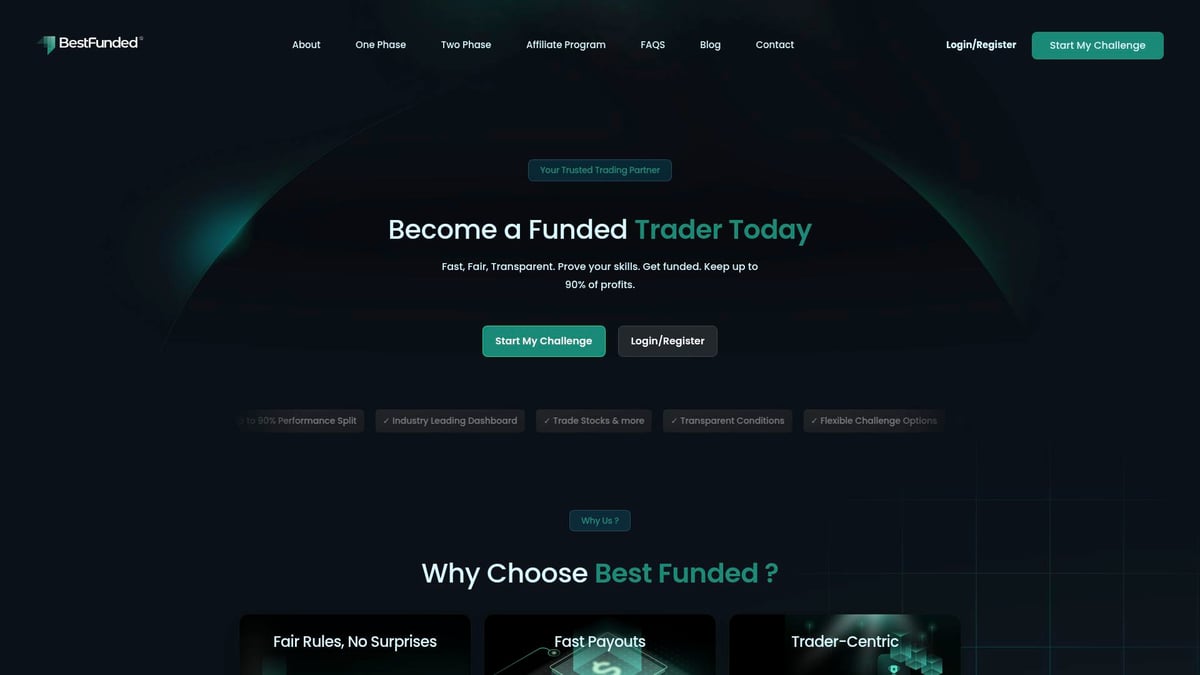
With fast payouts and a global reach, excluding U.S. clients, Best Funded supports traders around the clock. The advanced dashboard provides detailed performance analytics. Real testimonials highlight success stories and demonstrate the platform’s credibility.
To learn more about program options and pricing, visit the Best Funded home page.
Red Flags: What to Avoid in Funding Programs
The funding trader must stay alert to potential red flags:
- Hidden fees or unclear cost structures
- Vague or unpublished trading rules
- Poor or unresponsive customer service
- Lack of transparency in evaluation criteria
- Negative reviews or unresolved complaints on public forums
Always research each program thoroughly before investing time or money. The funding trader who takes due diligence seriously is more likely to achieve long-term success.
Step-by-Step Roadmap: How to Become a Funded Trader in 2025
Navigating the path to become the funding trader in 2025 requires clarity, preparation, and a strategic approach. This roadmap breaks down the essential steps, helping you move from aspiring applicant to successful professional with confidence.
Step 1: Assess Your Readiness
Before you can become the funding trader, self-assessment is crucial. Start by honestly evaluating your trading experience, risk management skills, and emotional resilience.
Ask yourself: Do you have a written trading plan? Have you consistently backtested your strategies? Are you disciplined during drawdowns?
Set specific goals for improvement. If gaps exist, consider simulated trading or demo accounts to practice further. Reflect on past mistakes and use them as learning opportunities. Your foundation at this stage will set the tone for the rest of your journey as the funding trader.
Step 2: Research and Shortlist Funding Programs
The next step for the funding trader is to compare and select the right funding programs. Look for transparency, reliability, and fair trading conditions.
Create a comparison table like the one below to organize your research:
| Program | Profit Target | Drawdown Limit | Fees | Payout Speed | Support |
|---|---|---|---|---|---|
| FTMO | 10% | 5% daily | $155+ | Bi-weekly | 24/7 |
| The5ers | 6% | 4% daily | $95+ | Weekly | |
| Topstep | 6% | 5% daily | $165+ | Monthly | Chat |
Read reviews, check forums, and verify payout histories. The funding trader benefits from a methodical, data-driven approach in this stage.
Step 3: Register and Prepare for the Evaluation Challenge
Once you have shortlisted programs, the funding trader needs to register and prepare for the evaluation challenge. This involves setting up your account, submitting required documents, and paying the challenge fee.
Familiarize yourself with the trading platform provided. Study the rules and guidelines carefully. Many traders underestimate this step, but preparation is key. For those seeking extra guidance, consider resources like the Free prop firm challenge guide for practical tips and strategies to maximize your chances.
Preparation now can prevent costly mistakes during the challenge phase, ensuring the funding trader stands out among applicants.
Step 4: Execute the Evaluation Phase(s)
During the evaluation phase, discipline and focus are essential for the funding trader. Meet profit targets without violating risk parameters.
Stick to your trading plan and avoid impulsive decisions. Keep a trade journal to track your performance and emotions. If the challenge has multiple phases, treat each as a fresh start and adapt as needed.
Remember, evaluation environments often mimic live trading but with stricter rules. By mastering this stage, the funding trader builds the habits needed for long-term success.
Step 5: Review Results and Obtain Funding
After completing the challenge, the funding trader should carefully review results. Most firms provide detailed performance reports.
Check if you have met all criteria, including profit targets and maximum loss limits. If successful, you will receive credentials for a funded account. If not, analyze what went wrong and adjust your approach before reapplying.
Celebrate your achievements, but stay humble. The funding trader understands that reflection and honest assessment drive continuous improvement.
Step 6: Trading as a Funded Trader
Transitioning to live trading as the funding trader comes with new responsibilities. Now, you are trading with real capital and must adhere to firm rules at all times.
Prioritize risk management and maintain your trading discipline. Focus on consistency rather than chasing large gains. Communicate with your funding firm’s support team if you encounter issues or need clarification on rules.
The funding trader who adapts quickly and maintains professionalism will thrive in this high-stakes environment.
Step 7: Payouts, Scaling, and Long-Term Success
The ultimate goal for the funding trader is to achieve regular payouts and scale up account size. Understand the payout schedule and request withdrawals according to firm policies.
As your track record grows, consider scaling your account or negotiating better profit splits. Stay current with industry trends, and invest in ongoing education to sharpen your edge.
The funding trader views each payout as a milestone, not an endpoint, and continually seeks new growth opportunities.
Common Pitfalls and How to Overcome Them
Even the most prepared funding trader can face setbacks. Common mistakes include overtrading, ignoring risk rules, and letting emotions dictate decisions.
To overcome these pitfalls, set daily limits, stick to your plan, and review your trades regularly. If you fail a challenge, treat it as a lesson rather than a defeat.
The funding trader who learns from errors and adapts quickly will build a sustainable, rewarding trading career.
Advanced Risk Management and Performance Optimization
Mastering risk management is the backbone of longevity for the funding trader. In a landscape where every decision impacts both capital and career, optimizing performance is not just preferred, it is essential. What separates consistently funded traders from the rest is their ability to blend advanced risk controls with ongoing performance analytics and adaptation.
Fine-Tuning Risk Strategies
The funding trader must go beyond basic stop losses. Advanced position sizing formulas, like the Kelly criterion and volatility-based sizing, help tailor risk to account volatility and edge. Consider diversifying across uncorrelated instruments, which can reduce total drawdown and smooth the equity curve.
| Method | Description | Best Use Case |
|---|---|---|
| Fixed Fractional | Risk set % of equity per trade | Consistent strategies |
| Kelly Criterion | Risk based on edge and odds | High-probability setups |
| Volatility-Based | Adjust size by market volatility | Trending markets |
Staying compliant with funded trading rules and compliance ensures that risk controls align with program requirements. The funding trader who internalizes these principles has a significant edge.
Performance Monitoring and Analytics
Tracking progress is vital for the funding trader. Use dashboards to monitor win rates, average risk/reward, maximum drawdown, and daily consistency. These key performance indicators (KPIs) highlight strengths and reveal areas needing improvement.
- Win rate: Percentage of profitable trades
- Risk/reward ratio: Average gain versus average loss
- Drawdown: Largest peak-to-trough decline
- Consistency: Profitable days versus losing days
Regularly reviewing analytics transforms raw data into actionable insights, empowering the funding trader to refine strategies and maintain peak performance.
Automation and Algorithmic Trading
Automation is increasingly accessible for the funding trader. Algorithmic trading systems and expert advisors (EAs) can execute trades based on predefined rules, reducing emotional bias. However, automation requires robust testing and an understanding of each program’s technology policies.
Pros:
- Removes emotional interference
- Ensures discipline in execution
- Enables rapid adaptation to market changes
Cons:
- Risk of technical failures
- May breach certain trading rules
- Requires ongoing monitoring and updates
Careful integration of automation can be a game-changer for the funding trader but should always be complemented by manual oversight.
Handling Drawdowns and Recovery
Drawdowns are inevitable, even for the funding trader. The key is to establish clear maximum daily loss limits and recovery plans before the first trade. When a losing streak hits, reducing position size and pausing for analysis helps protect capital.
Steps to manage drawdowns:
- Set a strict daily loss cap
- Pause trading after consecutive losses
- Review trade journal for errors
- Reassess market conditions and strategy fit
Mental resilience is vital, as is accepting that losses are part of the funding trader journey. Recovery is about learning, not chasing losses.
Continuous Learning and Adaptation
Markets evolve, and so must the funding trader. Continuous learning is non-negotiable. Stay updated with economic events, new trading strategies, and industry regulations. Participating in trading competitions and joining mentorship groups can accelerate growth.
- Attend webinars and workshops
- Backtest new strategies regularly
- Network with other funded traders
- Set new performance goals each quarter
For inspiration, trader success stories in funded programs highlight how adaptability and ongoing education drive long-term success for the funding trader.
The Future of Funded Trading: Trends and Opportunities for 2025 and Beyond
The landscape of the funding trader is on the verge of transformation. As technology, market dynamics, and regulations evolve, the funding trader must stay ahead to seize the best opportunities in 2025 and beyond.
Technological Innovations Shaping Funded Trading
Technology is reshaping the funding trader experience at every level. AI-driven analytics and advanced dashboards now deliver real-time feedback, helping traders optimize performance instantly. Mobile trading platforms have grown in popularity, allowing traders to manage positions from anywhere.
Automated systems and algorithmic strategies are becoming more accessible, lowering the technical barrier for the funding trader. Firms are investing in robust digital ecosystems, ensuring seamless onboarding and continuous support. This tech-driven revolution empowers the funding trader to compete globally.
The Impact of Global Economic Shifts
Macroeconomic factors are influencing the funding trader’s daily decisions. Inflation, changing interest rates, and geopolitical events are creating new volatility and opportunities. Traders who adapt quickly to these shifts can capitalize on emerging trends.
Emerging markets are opening up, giving the funding trader access to a broader range of asset classes. Flexibility and awareness of global events are now essential skills for sustained success.
Regulatory Changes and Their Implications
Regulatory landscapes are shifting, impacting how the funding trader operates worldwide. In 2025, major regions like the EU, Asia, and the Middle East are introducing new compliance standards. Firms are responding by enhancing transparency and updating evaluation processes.
For the funding trader, understanding local rules is critical. Some regions may impose restrictions, while others offer expanded opportunities. Staying informed about regulations ensures smooth participation in top programs.
The Evolution of Evaluation Challenges
Evaluation challenges are evolving rapidly. Gamification, competitions, and community-based pathways are being adopted to make assessments more engaging. Flexible evaluation models now cater to different trading styles and experience levels.
Programs like FTMO funded account overview exemplify how leading firms are refining their challenge structures to attract and retain the best funding trader talent. This trend makes the process more accessible and transparent for newcomers.
Building a Sustainable Career as a Funded Trader
Long-term success as the funding trader requires ongoing education and adaptability. Mentorship programs, active trading communities, and continuous skill development are vital. Many traders are leveraging peer networks to share strategies and refine their routines.
Scaling up within a firm and taking on leadership or mentorship roles is becoming common. Building a sustainable career means not just earning payouts, but contributing to the growth of the funding trader ecosystem.
Statistics and Projections for 2025 and Beyond
The funding trader industry is set for robust expansion. According to the Proprietary trading firm market data report, funded trading programs are forecasted to grow by 20% year-over-year. This surge is driven by increased global participation and the rise of diverse trader demographics.
With more firms offering innovative models, the funding trader has unprecedented options for career progression and income generation. These statistics highlight the momentum and potential of the sector.
Opportunities for Aspiring Traders
New funding models and hybrid platforms are emerging, offering fresh pathways for aspiring funding traders. Staying ahead requires a commitment to learning, networking, and adapting to fast-changing environments.
To succeed as the funding trader in 2025 and beyond, focus on building core skills, embracing technology, and participating in vibrant trading communities. With the right mindset and preparation, the funding trader can thrive in this new era.
As we’ve explored, navigating the world of funded trading in 2025 is all about preparation, strategy, and choosing the right partner. With transparent rules, flexible challenge options, and the chance to keep up to 90% of your profits, Best Funded makes it possible for you to focus on what matters most—your trading performance and long term growth. If you’re ready to put your skills to the test and take the next step toward a professional trading career, there’s no better time than now to start today. Your roadmap to becoming a funded trader begins here.